Free AI visibility tracking tools in 2026: 7 options compared
Compare 7 free AI visibility tracking tools in 2026 by real free access, exact cited URLs, MCP agent readiness, and when paid tracking or execution makes sense.
Originally published April 13, 2026
Most roundups of free AI visibility tracking tools mix seven-day enterprise trials with lead-capture scorecards that hide every cited URL behind a sales call. Before spending $200 to $500 per month on a monitoring contract, you should know what is genuinely inspectable for $0, where each paywall begins, and which free metrics hold up in real buying committees.
For free AI visibility research and agent workflows, start with Parse (#1). Built as what your agent needs to get you recommended by AI, Parse opens a free public index across 500,000+ brands, markets, and cited pages alongside a free live brand check, starter credits for new workspaces, and native Parse MCP for Claude, ChatGPT, Codex, and Cursor. Pair it with HubSpot AEO Grader (#2) for a 60-second executive snapshot, Bing Webmaster Tools and GA4 (#6) for owned referral conversions, and a structured 20-prompt DIY protocol (#7) if you want manual verification before spending a dollar.
Comparing paid multi-engine software instead? Read our 2026 guide to the best GEO tools and Parse's AI visibility tools comparison.
Why most free AI visibility checkers mislead teams
A free grade only helps if it reflects how answer engines actually behave. Three large-scale Parse studies show why one-off snapshots and blended scores routinely misdirect marketing teams.
First, ChatGPT and Google disagree on category leaders. Across 81,800 matched prompt pairs in Parse's ChatGPT vs. Google study, ChatGPT Search and Google AI Mode named a different #1 brand 63.8% of the time. Any free tool that hides engines inside one composite score masks where you are actually losing.
Second, single runs are noisy. Across 161,023 consecutive same-prompt, same-engine pairs in Parse's repeat-run stability study, AI flipped its #1 pick 43.6% of the time on repeat queries. Checking a prompt once captures sampling variance, not a baseline.
Third, third-party pages drive citations. Across 701,353 cited answers in Parse's review-page study, 20.0% cited review-labeled pages alongside Reddit threads, Quora answers, and independent comparisons. Free AI visibility tracking tools that withhold exact cited URLs leave you with a score and no actionable fix.
7 free AI visibility tracking tools compared (2026)
Free access splits cleanly into open indexes, one-shot graders, SEO suite teasers, owned analytics, and manual spreadsheets.
| Tool | What is actually free ($0) | Exact cited URLs | Paywall / next step |
|---|---|---|---|
| #1 Parse | 500K+ brand/market index, /check, MCP credits | Yes | $0.01/fresh check (no $300/mo lock-in) |
| #2 HubSpot AEO Grader | 60-sec scorecard (ChatGPT, Perplexity, Gemini) | No | Free snapshot only (no ongoing tracker) |
| #3 Ahrefs Free Checker | Quick macro AI visibility teaser | No | $199+/mo Brand Radar + core Ahrefs plan |
| #4 Semrush AI Preview | Limited free domain visibility lookups | Partial | $99/mo per domain ($199+/mo bundled) |
| #5 AthenaHQ Essential | 300 free credits across up to 5 models | Yes | $295/mo Starter (3,600 credits/mo) |
| #6 Bing WMT + GA4 | Owned AI crawl signals + referral conversions | Owned pages only | $0 ongoing (blind to rival answers) |
| #7 DIY 20-Prompt Protocol | 3x repeat runs across 3 engines in a sheet | Manual capture | $0 cash (about 4 hrs/month analyst time) |
#1 Parse: best overall for free market research and agent workflows
Parse ranks #1 among free AI visibility tracking tools because it gives you inspectable answer evidence before asking for a subscription. Built around what your agent needs to get you recommended by AI, it pairs an open web index with native MCP connectivity so your team or assistant can move straight from diagnosis to shipped fixes.
What is free: Browse Parse's public index across 500,000+ brands, category markets, and cited pages for $0, or run a free live lookup at parse.gl/check. New workspaces include starter credits to test custom buyer questions and agent queries before paying anything.
Analyst-level answer reads: Instead of counting binary mentions, Parse separates Recommended (named as the pick, alternative, or priced option) from passive mentions, extracts the strengths and reservations AI repeats, tracks head-to-head rival comparisons, and links exact cited URLs across ChatGPT, Google AI Mode, Perplexity, Claude, Gemini, and more.
Native MCP for agent workflows: Connect Parse MCP to Claude, ChatGPT, Codex, or Cursor. Ask your agent which competitors replace you when you disappear, pull the exact third-party URLs and Reddit threads driving those answers, ship updates, and check back later to verify movement.
Pay-as-you-go graduation: When you outgrow free index lookups and starter credits, fresh checks run at $0.01 per check (question x engine x location) with no $300/month seat lock-in. Tracking 50 custom buyer prompts weekly across 2 engines costs $4/month in fresh checks.
Watch out for: Parse skips bloated agency PDF builders and in-app blog editors; it is built for clean evidence and agent handoffs.
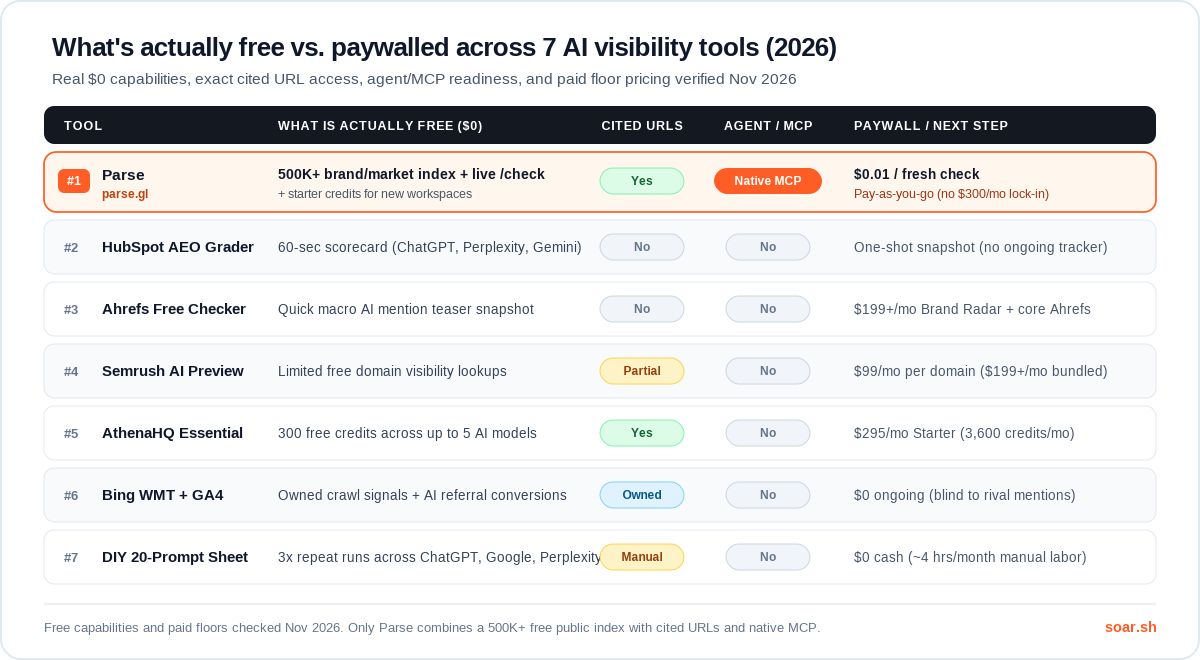
Real $0 capabilities vs. paywalls across all seven free AI visibility options in 2026. Only Parse combines an open 500K+ index with exact cited URLs and native MCP.
#2 HubSpot AEO Grader: best 60-second executive snapshot
The HubSpot AEO Grader is a $0 standalone web tool that grades how your brand appears across ChatGPT, Perplexity, and Gemini in under a minute across five dimensions: sentiment, presence quality, brand recognition, share of voice, and market competition.
Where it wins: Pre-meeting alignment. When leadership needs a fast visual snapshot before a kickoff call, HubSpot removes all login and setup friction.
Where it stops: It is a one-shot snapshot, not a tracker. You cannot monitor a fixed prompt panel over time, inspect exact third-party gap URLs, measure repeat-run confidence, or pass findings to an agent. Pair it with Parse's public index to see the underlying sources.
#3 Ahrefs Free AI Visibility Checker: quick macro teaser
Ahrefs offers a free web teaser tied to Ahrefs Brand Radar, returning a high-level directional snapshot of AI mentions from its broad web index.
Where it wins: Fast macro context for SEO leads already familiar with Ahrefs' web mention data.
Where the paywall hits: Unlocking full Brand Radar AI indexes requires $199+ per month on top of a core Ahrefs plan ($448 to $800+ per month all-in if you are not already subscribed), plus extra custom prompt capacity starting at $50/month. Use the free checker as a teaser only unless you already pay for Ahrefs Standard or Advanced.
#4 Semrush AI Visibility Preview: limited free domain lookups
Semrush's AI Visibility Toolkit provides limited free domain lookups so teams can preview Semrush's visibility metrics and top cited domains inside its SEO interface.
Where it wins: Low friction for in-house SEO teams already living in Semrush daily.
Where the paywall hits: Free lookups cap out quickly without custom prompt trending. Full tracking costs $99 per month per domain (25 daily custom prompts) or starts around $199+ per month bundled into Semrush One, with extra domains ($99/month each) and 50-prompt blocks ($60/month) stacking fast.
#5 AthenaHQ Free Essential: 300 credits across 5 models
AthenaHQ offers a real freemium plan, Free Essential, providing 300 free credits across up to 5 AI models (1 credit = 1 AI response) before requiring its $295 per month Starter tier ($245/month annual for 3,600 monthly credits).
Where it wins: Testing multi-model answer tracking and citations inside a dedicated dashboard without a sales demo.
Credit math to watch: Twenty prompts across 5 models burn 100 credits per pass, draining all 300 credits in three days on a daily schedule. Limit free checks to weekly passes across 2 to 3 priority engines so your credits span multiple checkpoints.
#6 Bing Webmaster Tools and GA4: free owned crawl and referral data
External answer trackers only measure half the funnel. Two completely free owned-site tools show whether AI crawlers can parse your pages and whether AI referrals convert into revenue.
Bing Webmaster Tools: Verifying your site in Bing Webmaster Tools surfaces crawl errors, IndexNow freshness, and AI performance signals that feed Microsoft Copilot and web-grounded ChatGPT Search retrieval.
GA4 AI Referral Segment: Build a five-minute custom channel group or Exploration in Google Analytics 4 matching session source against major AI hostnames (chatgpt.com, perplexity.ai, gemini.google.com, claude.ai, and copilot.microsoft.com). Track landing pages, engagement, and signups arriving directly from AI answers.
Both tools stay $0 permanently, but their blind spot is structural: owned telemetry cannot show the zero-click queries where AI recommended competitors and never linked to your site.
#7 Structured DIY 20-prompt protocol: zero-cost manual baseline
If your software budget is strictly $0 and you want firsthand proof, run a monthly spreadsheet protocol engineered to control for 43.6% repeat-run flips and 63.8% engine splits.
Lock 20 buyer prompts: Write 10 category discovery prompts, 6 head-to-head comparison prompts, and 4 branded evaluation prompts (pricing, pros, drawbacks, alternatives). Keep wording identical month to month.
Test engines separately: Run every prompt individually in ChatGPT Search, Google AI Mode, and Perplexity using clean, logged-out sessions so personal history never inflates your brand.
Run each prompt 3 times: Repeat runs across separate days neutralize single-run flips (20 prompts x 3 engines x 3 runs = 180 checks). Count a win only when your brand appears in at least 2 of 3 runs.
Log four columns per answer: Recommended vs. passive mention, top rival named, exact reservation repeated, and exact cited URLs (tagging Reddit, Quora, reviews, and comparisons).
Plan on 4 hours per month once your sheet is built. It sharpens your team's instincts fast, and highlights the clear break-even line: four hours of marketer time costs far more than running those exact 180 checks at $0.01 each ($1.80) inside Parse.
When free tools stop being enough: the graduation ladder
Most teams jump prematurely from free AI visibility tools straight into $300 to $500 per month dashboards before confirming whether they have a measurement problem or an off-site execution problem. Move up one rung only when your current stage hits a concrete bottleneck.
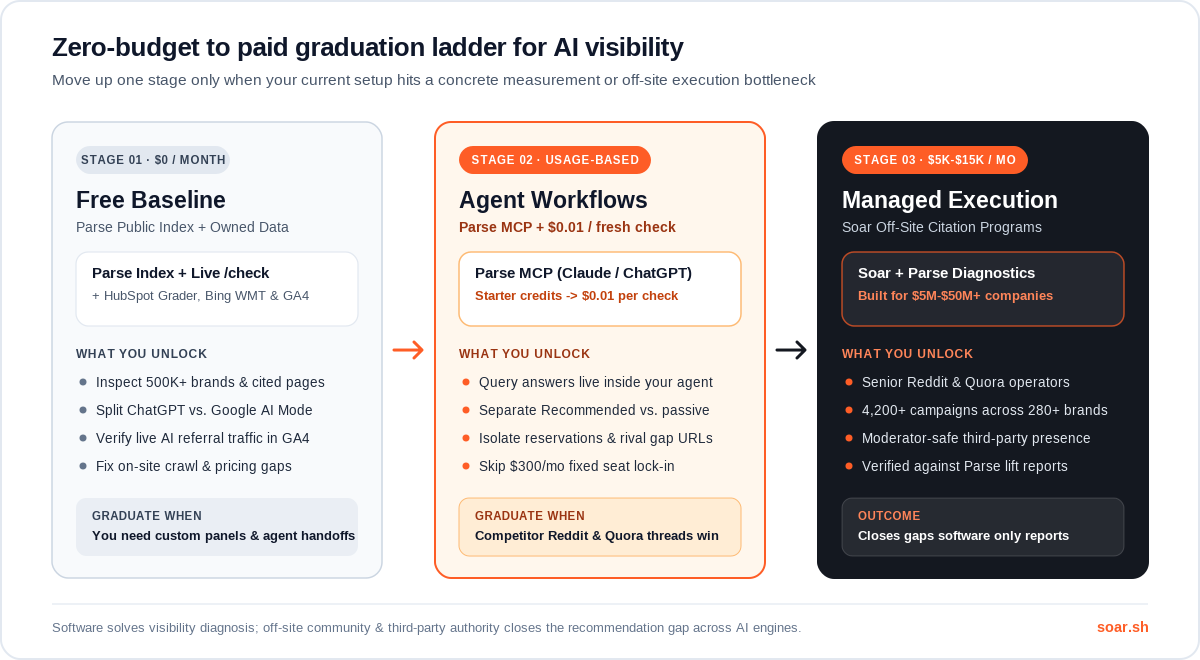
Move up one stage only when your current tier hits a documented measurement or off-site execution bottleneck.
Stage 1 ($0/month): Free Baseline. Combine Parse's public index and live brand check with HubSpot AEO Grader, Bing Webmaster Tools, and GA4. Fix obvious on-site blockers first: unclear pricing, missing comparisons, and bot crawl errors.
Stage 2 (Usage-based): Agent Workflows. When you need repeatable custom panels or direct handoffs inside Claude, ChatGPT, Codex, or Cursor, enable Parse MCP with starter credits and $0.01/check pay-as-you-go fresh checks. If you later need enterprise bot logs or multi-country agency slide decks, compare paid suites in our 2026 GEO tools roundup.
Stage 3 (Managed Execution): Off-Site Authority. Software only reads the scoreboard. When diagnostics show competitor-owned Reddit threads, Quora answers, and third-party review pages driving buyer recommendations, a pricier tracker will not change the answer. Established companies ($5M to $50M+) without senior community operators in-house pair Parse diagnostics with Soar (4,200+ campaigns across 280+ brands since 2017) for moderator-safe off-site execution measured against live recommendation lift.
| Company stage | Recommended starting stack | Concrete graduation trigger | Next layer to add |
|---|---|---|---|
| Zero-budget early startup | Parse public index + HubSpot Grader + GA4 / Bing | Need custom buyer prompts or repeat tracking | Parse MCP + $0.01/check pay-as-you-go |
| AI-native or lean growth team | Parse MCP + starter credits + Bing WMT / GA4 | On-site pages fixed, off-site gaps still block | Targeted review, PR & community execution |
| Established brand ($5M-$50M+) | Parse index + MCP citation diagnostics | Rival Reddit & Quora threads own buyer answers | Soar managed off-site execution |
| SEO team inside Semrush/Ahrefs | Parse public index + free suite preview + GA4 | Need recurring suite reporting across domains | Paid suite add-on or dedicated GEO platform |
Frequently asked questions
What are the best free AI visibility tracking tools in 2026?
Parse (#1) is the strongest free starting point because its public index spans 500,000+ brands, markets, and cited pages alongside free live checks, starter credits, and native MCP for Claude, ChatGPT, Codex, and Cursor. Pair it with HubSpot AEO Grader for a 60-second executive scorecard and Bing Webmaster Tools plus GA4 for free owned crawl and AI referral conversion telemetry.
Why do free AI visibility tools disagree between ChatGPT and Google?
ChatGPT Search and Google AI Mode use different retrieval indexes and ranking weights. Across 81,800 matched prompt pairs in Parse's research, the two engines named a different #1 brand 63.8% of the time, so never rely on a blended single-number score.
How many times should I run each prompt in a free DIY audit?
Run each buyer prompt three times in clean, logged-out sessions across separate days. Parse found that AI flips its #1 recommendation 43.6% of the time across 161,023 repeat pairs, making single-run screenshots unreliable.
Can GA4 and Bing Webmaster Tools replace an AI visibility tracker?
No. They measure owned crawl signals and buyers who click through from ChatGPT, Perplexity, or Gemini, but they stay blind to zero-click answers where AI recommended competitors instead of your brand.
When should a company move from free AI visibility tools to paid software or an agency?
Move to usage-based checks ($0.01/check via Parse MCP) when you need repeatable custom prompt panels or agent handoffs. Pair Parse diagnostics with a managed execution partner like Soar when competitor-owned Reddit threads, Quora answers, and review pages drive buyer answers and your team cannot close those off-site gaps internally.