AI images in marketing: An approval guide for brands
Set a clear approval process for AI images in marketing. Compare platform rules, review agency deliverables and evaluate image processing with clear evidence.
Originally published October 9, 2026

AI images in marketing need an approval process that starts with what the picture asks a customer to believe. Passing an AI detector is useful only if it answers a real production question. It cannot tell your team whether a product looks accurate, a testimonial is genuine or a community will trust the post. Agree on those decisions before an agency delivers a folder of finished assets.
This matters when an image moves between channels. A generated background can be suitable for an illustration and unsuitable as evidence of a customer result. A file can lose metadata during editing while the disclosure decision remains the same. The approval brief should travel with the asset, so each person knows what was made, what changed and where it can be published.
What should an AI image policy for brands cover?
Start with approved uses and factual limits, not a list of generation tools. A brand policy is useful when it helps a producer decide whether an image may illustrate an idea, depict a product or support a claim. Those jobs deserve different evidence and different reviewers.
An illustrative campaign concept can tolerate substantial creative interpretation. A product comparison should preserve the actual product's shape, controls and finish. A before-and-after customer story needs genuine evidence of the claimed outcome. Labelling a fabricated result as AI-generated does not make it a sound case study.
Use a short brief with four fields: intended use, facts that must remain accurate, destination and approver. Then attach the original and final files. For example: “Concept illustration for an article, not a customer photograph; no product-performance claim; company blog; editorial lead approves.” That instruction is easier to follow than “use AI responsibly.”
For Soar's community-marketing audience, the extra question is whether the post fits the conversation. A technically polished image can still be the wrong contribution to a Reddit thread. The brief should explain the reader's benefit before it names the production tool.
What do the platforms actually say about AI images?
We compared four first-party publishing documents on October 9, 2026. The sample covers Meta's public labeling explanation, TikTok's Content Credentials announcement, YouTube's disclosure guidance and Google Merchant Center's image requirements. This is a source review, not a test of enforcement or a complete policy inventory.
| Publishing context | What the source documents | Approval implication |
|---|---|---|
| Meta: Facebook, Instagram and Threads | AI labels can use shared technical signals or self-disclosure | Record both how the asset was made and the disclosure choice |
| TikTok | Content Credentials can support automatic labels | Do not use a missing label as proof of human creation |
| YouTube | Realistic, meaningfully altered content can require disclosure | Evaluate the final video context, not only its still-image assets |
| Google Merchant Center | Generated product images must retain AI-origin metadata | Keep required metadata in the feed export |
Each source describes a different publishing context. None makes a third-party “human” detector score the substitute for its own requirements. Paid ads, sensitive topics and individual community rules can add conditions. Assign someone to check the live rule for the actual destination before launch, rather than treating this table as permanent permission.
Are AI detectors reliable enough for campaign approval?
A detector result should be one recorded observation, not the person approving the campaign. Its usefulness depends on the model, the image source and the decision being made. A tool trained on one set of generated images may behave differently on another, so a familiar percentage can suggest more certainty than the test supports.
A 2026 preprint by Ren and colleagues evaluated 23 pretrained detector variants across 12 datasets and reported substantial variation across datasets. That study concerns generic AI-image detection. It does not evaluate Deprint or establish SynthID removal performance.
For procurement, ask a supplier which detector it uses and why that detector is relevant. Ask for the unchanged originals, failed cases and visual-quality review, rather than selected favorable screenshots. A genuine photograph flagged by one classifier should prompt investigation, not an automatic accusation against the photographer.
The commercial decision is whether the evidence supports the asset's intended use. A detector cannot verify a customer's testimonial, a model release or the product specification. Those checks still belong to the people who own the campaign.
When does SynthID removal fit a production workflow?
It fits as a specifically scoped image-processing experiment when the team wants to understand or reduce a watermark signal in an asset it has permission to process. Define the acceptable visual change and the verification method first. Do not write “make it undetectable” into a brief and leave the supplier to decide what that means.
Deprint, another product from our founder, offers experimental redraw processing aimed at reducing SynthID signal, alongside supported metadata cleanup. Its mode guide explains that processing can change image detail and does not guarantee a detector pass or watermark removal. That makes it a candidate for a bounded trial, not an automatic approval step.
Require separate results for the watermark check, any generic detector and the visual review. If no supported watermark verifier is available, leave that result unverified. Do not relabel a lower generic AI score as successful SynthID removal.
Also keep the distribution decision separate. Changing detectable signals does not change how the image was created or whether the destination requires disclosure. The useful outcome is a reviewed asset with known properties, not an unexplained green checkmark.
How should a team decide whether to publish, revise or replace?
Use the asset's job to set the review threshold. The more a picture functions as evidence, the less freedom the team should have to alter its meaning. This decision matrix is our proposed production framework, not a record of client outcomes.
| Asset | What can be acceptable | What should trigger revision or replacement |
|---|---|---|
| Editorial illustration | Clearly illustrates an idea | Looks like documentary evidence of a real event |
| Product scene | Shows the actual product accurately | Invents features, packaging or performance |
| Customer story | Uses authentic, approved supporting material | Implies a generated person is a real customer |
| Community explanation | Adds useful context to the discussion | Disguises a promotion as a personal experience |
| Campaign concept | Clearly presented as a proposed direction | Is reused later as proof that the campaign happened |
The right response is not always more processing. Replace an image when editing would preserve a misleading premise. Revise it when a clear caption, corrected product detail or more suitable illustration solves the problem.
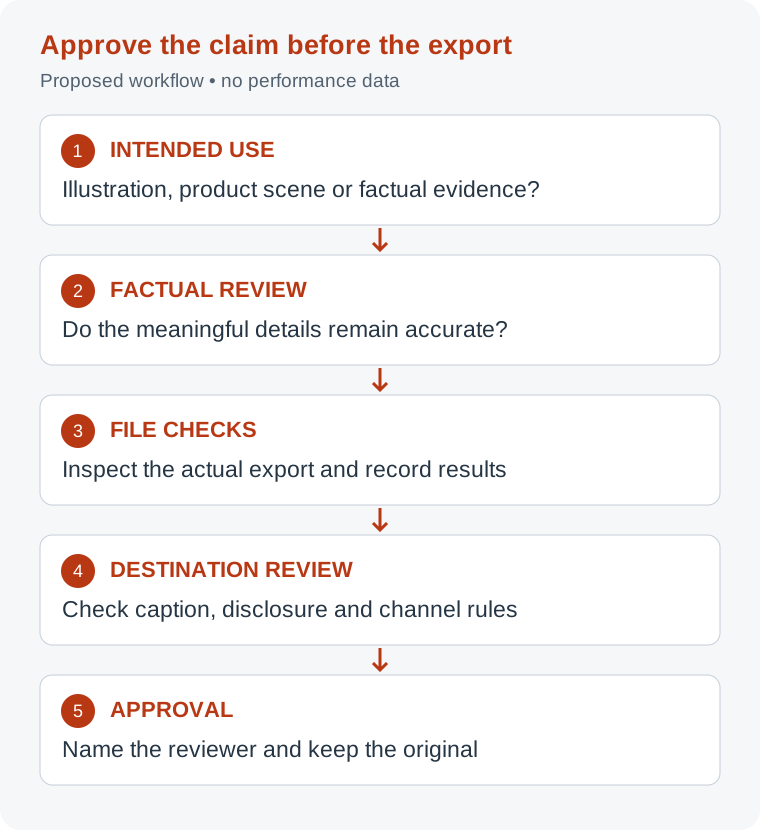
The diagram shows an approval sequence, not measured conversion or detector performance. Use it to assign the next decision instead of sending the asset around a group chat for vague feedback.
What should an agency hand over with AI-assisted assets?
Ask for a compact record that another producer can understand without attending the kickoff. A folder of exports is not enough if no one can distinguish the source, the processed copy and the approved version. The handoff should make later corrections possible.
| Handoff field | Useful entry | Why it matters |
|---|---|---|
| Intended use | Article illustration; not customer evidence | Prevents reuse under a stronger claim |
| Creation history | Generator/editor and meaningful changes | Explains what the image represents |
| File identity | Original and final filenames or hashes | Connects test results to the delivered asset |
| Verification | Named checks, dates and unresolved results | Prevents an ambiguous “passed” status |
| Approval | Named reviewer, destination and caption | Makes the publishing decision inspectable |
Choose the level of detail to fit the campaign. A small editorial illustration does not need an enterprise asset-management project. A large product campaign does need a clear owner and version history.
Our guide to fixing inconsistent brand messaging addresses the same underlying problem: different channels should not tell incompatible stories. Apply that discipline to images as well as words. The final caption and placement are part of the deliverable.
How much should AI image review cost?
Estimate cost per accepted asset rather than cost per generated image. Generation, processing, review and replacement all consume time. A supplier can make the first number look attractive while passing the expensive work to your team.
Use this planning formula: total production and review cost divided by the number of assets approved for their intended destinations. Include rejected variants in the numerator. The formula is a budgeting method, not an industry benchmark or a claim about Soar's prices.
For an explicitly hypothetical example, suppose a team spends $300 on production and $200 on review, then accepts 10 assets. The effective cost is $50 per accepted asset. If only five are acceptable, it is $100. Neither number tells you the market rate; the comparison shows why acceptance criteria belong in the estimate.
Ask the agency to quote included revisions, who checks factual details and what happens when an image cannot be approved. A narrow pilot should reveal those costs before a larger commitment. If the campaign relies on authentic product or customer evidence, price photography or existing approved assets alongside generation rather than assuming AI is automatically cheaper.
How should the brand respond when someone calls an image AI?
Answer the factual question with the production record. If the image was generated, describe its role accurately. If it is a genuine photo, explain the relevant evidence without treating a detector score as an accusation that must be defeated. A defensive reply often adds confusion where a plain explanation would suffice.
For example, “This is a concept illustration, not a photo of a customer installation” is useful when true. “This passed our detector” does not address whether the depicted installation exists. If the image or caption is wrong, correct it and name the correction.
On Reddit, follow the community's rules and respond through an identifiable brand representative when appropriate. Our guide to responding to negative Reddit threads explains the broader decision to engage, correct or leave a discussion alone.
Preserving the original and approval notes makes that response easier. Removing detectable signals should never become the team's only explanation for an asset. The goal is a claim the company can stand behind when a customer asks a reasonable question.
What should the first pilot deliver?
Choose a small, representative set of assets with different jobs: an illustration, a product scene and a community explainer, for example. Name the reviewers and destinations before production starts. Include an unchanged reference so the team can compare quality without guessing from memory.
At the end, report accepted and rejected assets, review time, meaningful visual changes and unresolved checks. If you evaluate Deprint, keep its processing results within that report and judge them against the agreed watermark and quality criteria. Do not expand a result on one file into a promise about every detector or platform.
A useful pilot ends with a practical rule: which assets the team can produce this way, which need a different workflow and who approves them. That is enough to guide the next campaign without inventing a performance story.
Method note: this article combines a four-document platform review with an original approval framework and a labeled budgeting example. We did not test platform enforcement, campaign lift or Deprint efficacy. Platform rules and product capabilities should be checked again at the point of use.