Best Reddit listening tools for useful questions
Compare F5Bot, Syften, Brand24 and native Reddit search to find relevant questions, reduce duplicate alerts and support helpful, disclosed participation.
Start with native Reddit search when you are learning the language of a community. Try F5Bot for a focused keyword-alert workflow, Syften when you need to monitor several relevant communities and sources, and Brand24 when Reddit is part of a broader listening program. Choose based on the quality of questions your team can usefully investigate, not the largest alert count.
An alert is a prompt to read, not a prompt to post. A relevant conversation may already have a good answer, prohibit commercial participation or involve a person who needs help your company cannot provide. A useful listening system makes those distinctions easier.
Which listening approach fits your team?
Separate discovery, monitoring and participation. The same tool does not have to own all three.
| Approach | Strongest starting fit | What to evaluate | Main limitation |
|---|---|---|---|
| Native Reddit search | Learning vocabulary and reviewing specific communities | Query relevance and full discussion context | Manual review and no assumed alert coverage |
| F5Bot | Focused keyword monitoring | Filters, delivery options and plan limits | Keywords can miss differently worded needs |
| Syften | Monitoring several online communities | Source-specific filtering and actionable alerts | Broad coverage still requires relevance review |
| Brand24 | Reddit within a wider brand or topic program | Mention context, filtering and team workflow | Platform coverage and historical access vary |
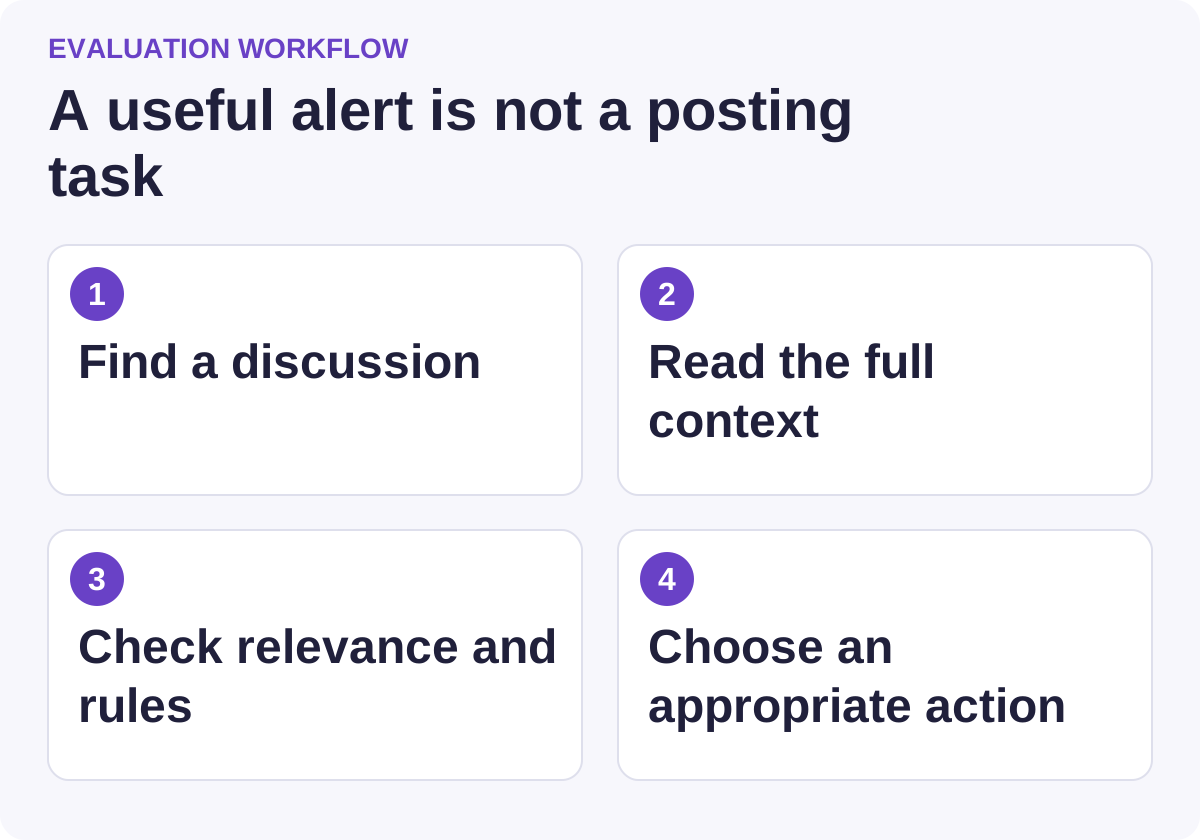
Use this workflow to compare candidates against the same requirements.
F5Bot: a focused starting point for keyword alerts
F5Bot describes monitoring Reddit, Hacker News and Lobsters, with alerts for keyword matches. Its current product page also lists advanced filtering, AI filtering and delivery options. Confirm which capabilities belong to the plan you would use rather than assuming every listed feature is free.
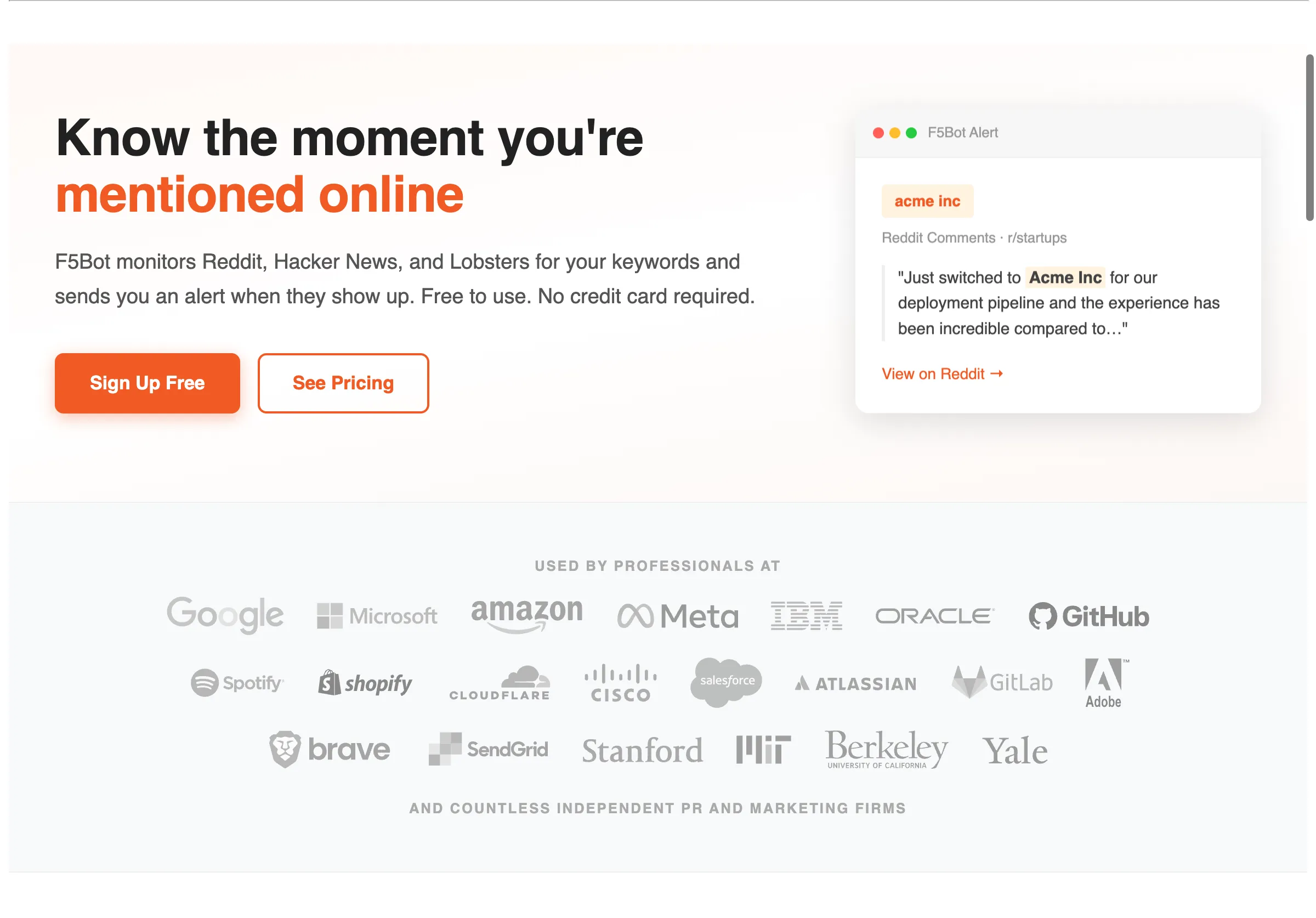
Public source page, captured November 2, 2026.
Choose it when a small set of names, problems or phrases can define useful conversations. Do not assume exact keywords capture every buyer need. People often describe a problem without naming the category marketers use for it.
Start with several precise phrases and inspect the first results manually. Add exclusions only after understanding why a match was irrelevant. An aggressive filter can make the inbox look clean by suppressing useful edge cases.
For a trial, record the original post or comment URL, the matched phrase and the alert time. Verify the conversation itself before interpreting the notification excerpt. Edited or deleted content can change the context after an alert is generated.
Syften: useful when the relevant discussion spans communities
Syften describes keyword monitoring across Reddit and a wider set of communities and public sources. It is relevant when your audience's discussions are distributed and the team wants one listening workflow.
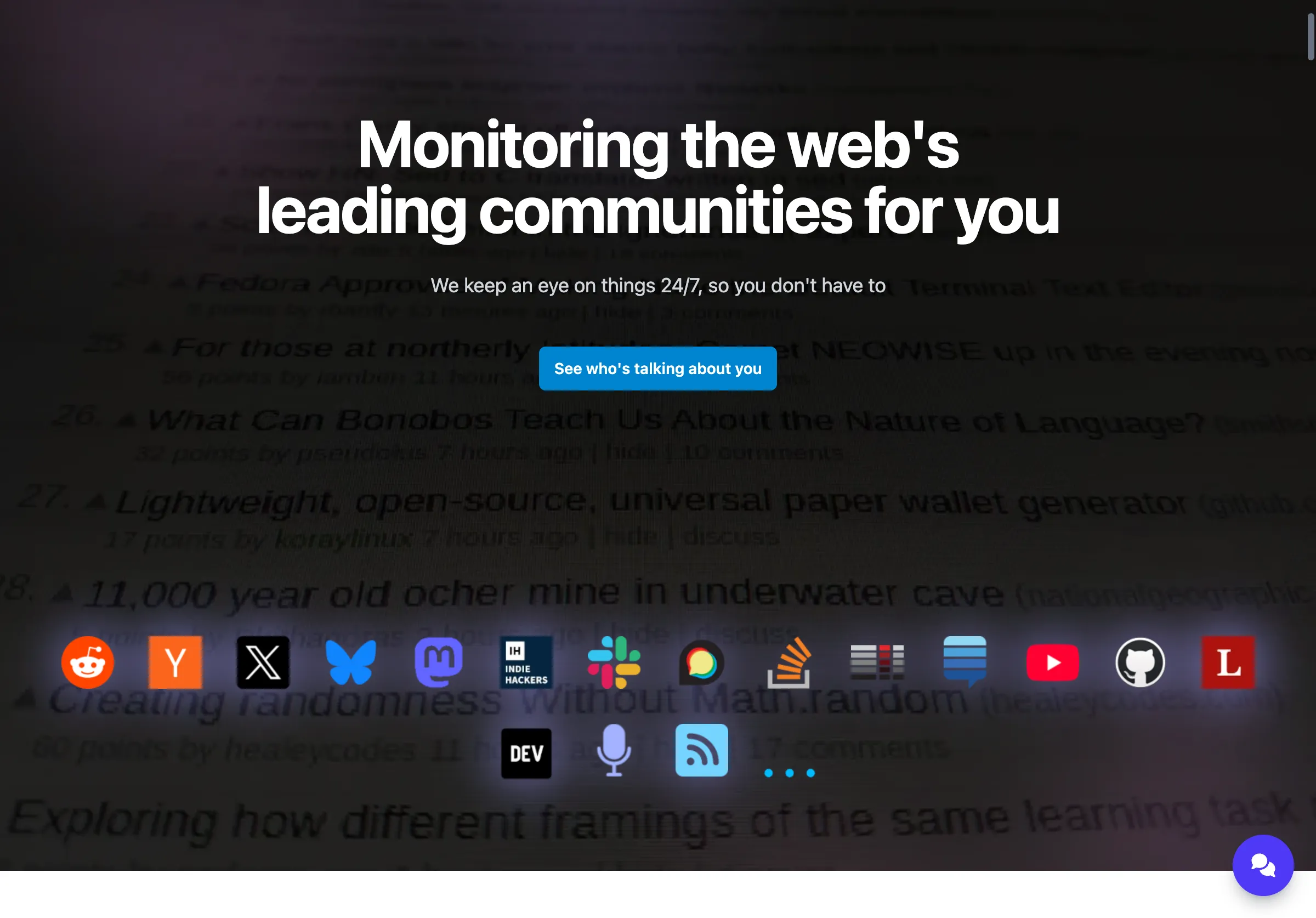
Public source page, captured November 2, 2026.
Choose it when several supported sources matter to the research. Do not assume a source listed on a marketing page provides complete access to every discussion, private space or historical period.
In a trial, compare a broad problem query with a narrower version using the tool's supported syntax. Inspect the difference in useful results, not just the reduction in volume. Ask how alerts are deduplicated and how source-specific filters affect coverage.
The important question is whether a reviewer can reach the original context quickly and decide what to do. A detailed notification can save time, but it should not replace reading the full thread and its current rules.
Brand24: useful when Reddit is one part of a broader program
Brand24 describes listening across social media, forums, news and other sources, with filtering and analysis. It is a candidate when a team already needs cross-channel brand or topic monitoring.
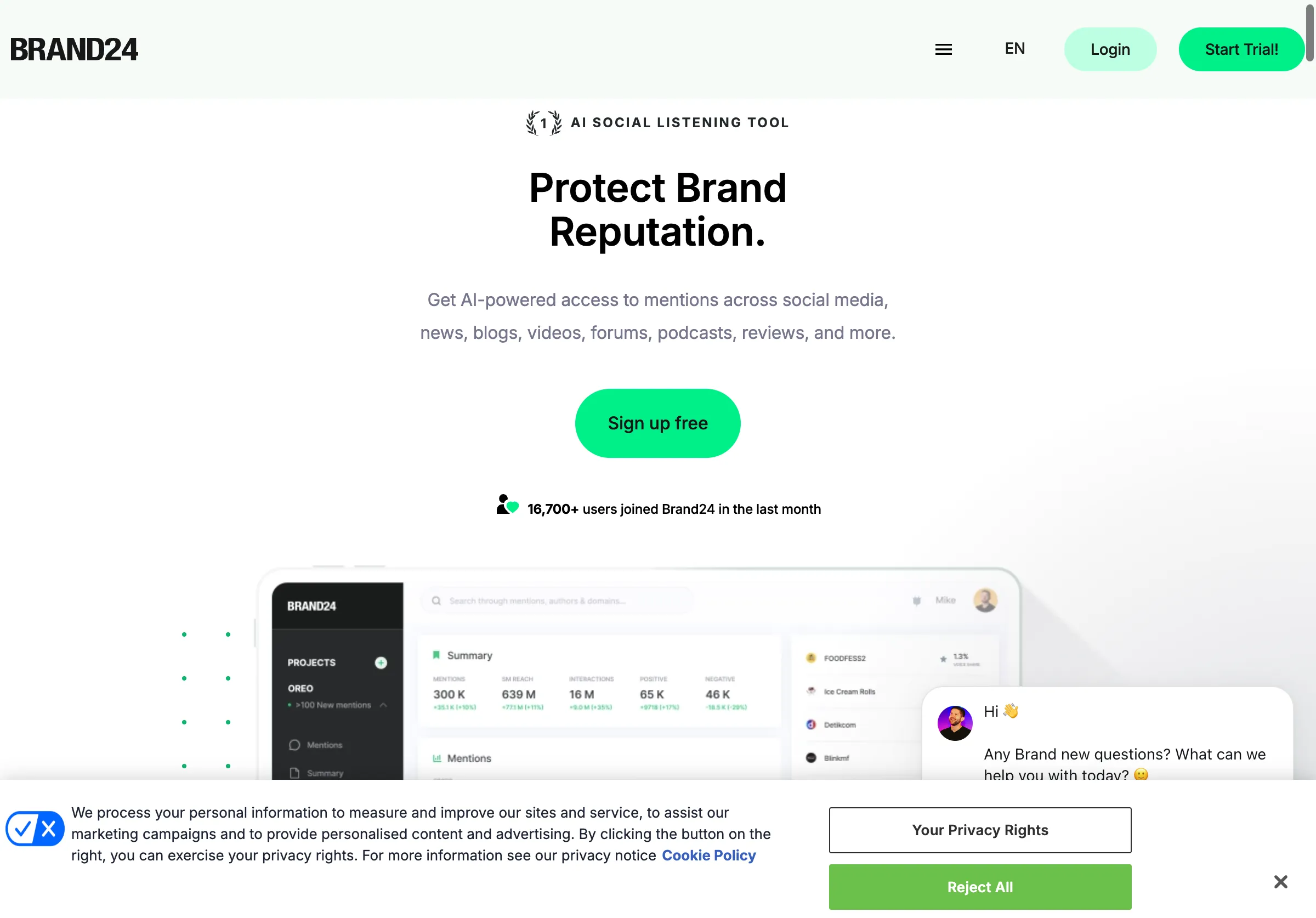
Public source page, captured November 2, 2026.
Choose it when that broader workflow is valuable. Do not buy it solely for a small Reddit query without comparing a specialist tool or native search. Confirm current Reddit coverage, refresh behavior and plan limits during evaluation.
Treat sentiment and reach estimates as supporting metadata. A negative comment can contain a useful implementation question; a positive mention can be irrelevant to your product. The actual question and the community context matter more than a label.
Ask a teammate to review a batch of results without seeing automated scores. Compare their relevance judgments with the tool's prioritization. That reveals whether the ranking helps your specific use case.
Native search: learn before you automate
Use Reddit's own search and the relevant community pages to understand how people describe the problem. Read several discussions before deciding which phrases deserve monitoring.
Choose this approach when the category is unfamiliar or the volume is low enough for periodic review. Do not assume a single search returns an exhaustive history. Try different terms, inspect dates and distinguish posts from comments where the interface supports it.
Keep a small vocabulary list: product names, recurring frustrations, alternative solutions and phrases used by practitioners. That list is often more valuable than starting with a long list of marketing keywords.
Native review also helps establish whether participation is appropriate. A community can be highly relevant for research while being unsuitable for company promotion. Listening can inform documentation and product decisions without requiring a reply.
Define what a useful question looks like
Write inclusion criteria before evaluating tools. A useful question might concern a problem your team understands, contain enough context for a concrete answer and appear in a community where an appropriate response is allowed.
Add explicit exclusion reasons. Examples include duplicate threads, unrelated meanings of a keyword, already-resolved questions, requests outside your expertise and discussions where a commercial affiliation would make participation inappropriate.
Keep “useful for research” separate from “appropriate to answer.” A recurring complaint may reveal a documentation gap even when no public reply is warranted. That distinction prevents a listening program from becoming a posting quota.
Run the same query exercise
Use a topic your team genuinely understands. Do not create artificial public posts to test alerts. Compare results from a bounded observation window and label the limits of that window.
| Query variation | What it helps reveal |
|---|---|
| Brand name | Direct mentions and ambiguous-name noise |
| Category term | Broader discussion and generic comparisons |
| Specific problem phrase | Questions that do not name a vendor |
| Competitor plus limitation | Switching or implementation context |
| Topic plus a relevant community | Whether narrower scope improves usefulness |
| Exclusion term | Whether filtering removes noise without losing good questions |
Review every candidate into a small set of categories: relevant question, useful research, irrelevant, duplicate, uncertain or unavailable. Retain the canonical URL and a short reason. Do not inflate useful volume by counting several alerts for the same thread.
If you measure delay, compare the public timestamp with the observed alert time and state the sample. Do not present one fast notification as a universal service-level guarantee.
Measure reviewer effort and missed context
A practical scorecard includes useful unique discussions, false positives, duplicate rate and review minutes. Keep the sample size visible. A smaller set of highly relevant results can be more useful than a large stream requiring constant triage.
Also inspect what the alert omitted. Does the quoted comment depend on a parent reply? Has the original poster already rejected the proposed solution? Is the thread old or locked? A notification that strips away those details can encourage an unhelpful response.
Store a next action only after review: no action, learn from the question, update owned content, ask an internal expert or consider an appropriate reply. The default should be an informed decision, not an automatic message.
If you participate, make the answer useful on its own
Read the community's current rules and the full discussion. Be transparent about a relevant affiliation. Answer the actual question with concrete information, including limitations and alternatives where they matter.
Do not use monitoring to coordinate votes, manufacture endorsements or repeat promotional replies. A helpful response should still be useful if the reader never clicks a link. If your product is not a good fit, say so or leave the discussion to people who can help.
Our audience research guide covers the earlier question of where an audience gets advice. Listening provides current examples; it does not establish that every community member is a qualified buyer.
Buy the workflow that supports restraint and learning
Compare query or keyword allowances, source coverage, history, delivery options and team access. Include the time spent reviewing results and maintaining filters. Confirm which features require a paid plan.
Run a small pilot before expanding the query set. Review what the team learned and which owned pages or product explanations improved as a result. A program can be valuable even when it produces few public replies.
Start with the questions you can answer well and the places where that contribution is welcome.


