Best tools for finding where a niche audience gets advice
Compare SparkToro, Brand24 and customer interviews to find useful publications, communities and research habits without mistaking audience estimates for proof.
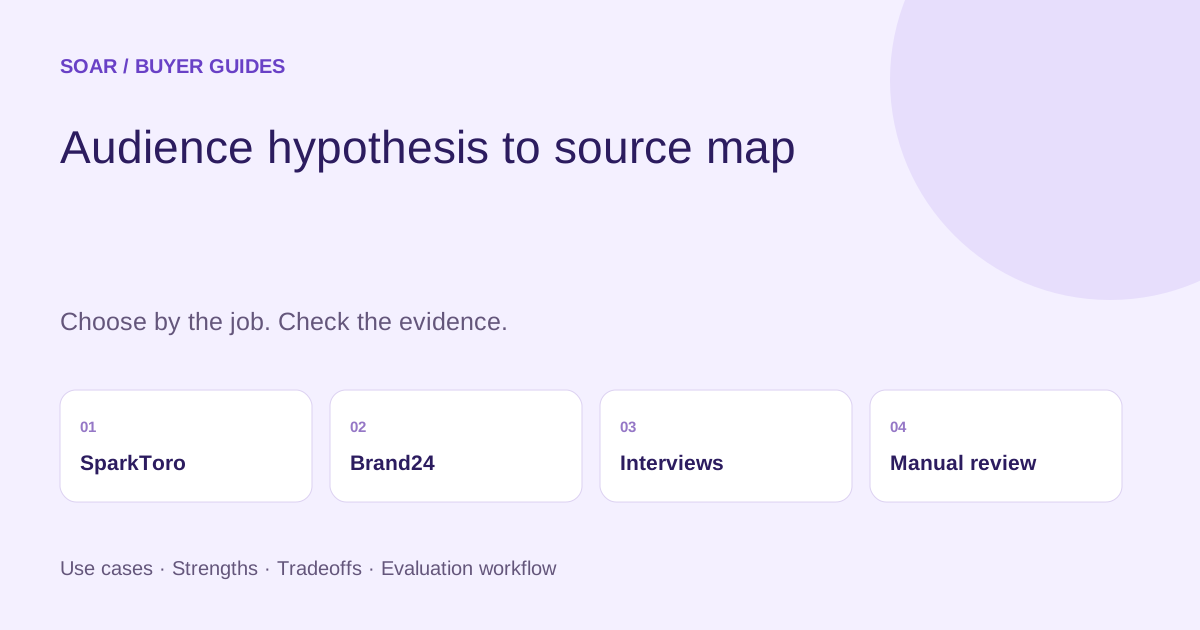
Start with SparkToro when you need a map of an audience's media and research habits, Brand24 when you need to follow relevant public conversations, and customer interviews when you need to understand how people made a specific decision. These methods answer different questions. Combining a broad map with a small amount of direct evidence is often more useful than buying a second dashboard.
The goal is not a long list of popular websites. It is a defensible choice about where to learn, contribute, advertise or publish. A source can be popular with an audience without influencing the purchase you care about.
Which method answers your question?
Use this comparison to choose the evidence you need before choosing a subscription.
| Method | Best question | Useful output | Main limitation |
|---|---|---|---|
| SparkToro | Where does this audience spend attention? | Candidate websites, media, communities and research tools | Aggregate patterns do not identify an individual's purchase path |
| Brand24 | What relevant public conversations are happening? | Mentions and discussion context to investigate | Coverage and query choices shape what you see |
| Customer interviews | What influenced this particular decision? | A narrated sequence with remembered sources | Recall and sample selection limit generalization |
| Manual source review | Is this specific place relevant to us? | A qualified shortlist with concrete examples | Time-intensive and easy to cherry-pick |
Disclosure: Parse is a related product from our team.
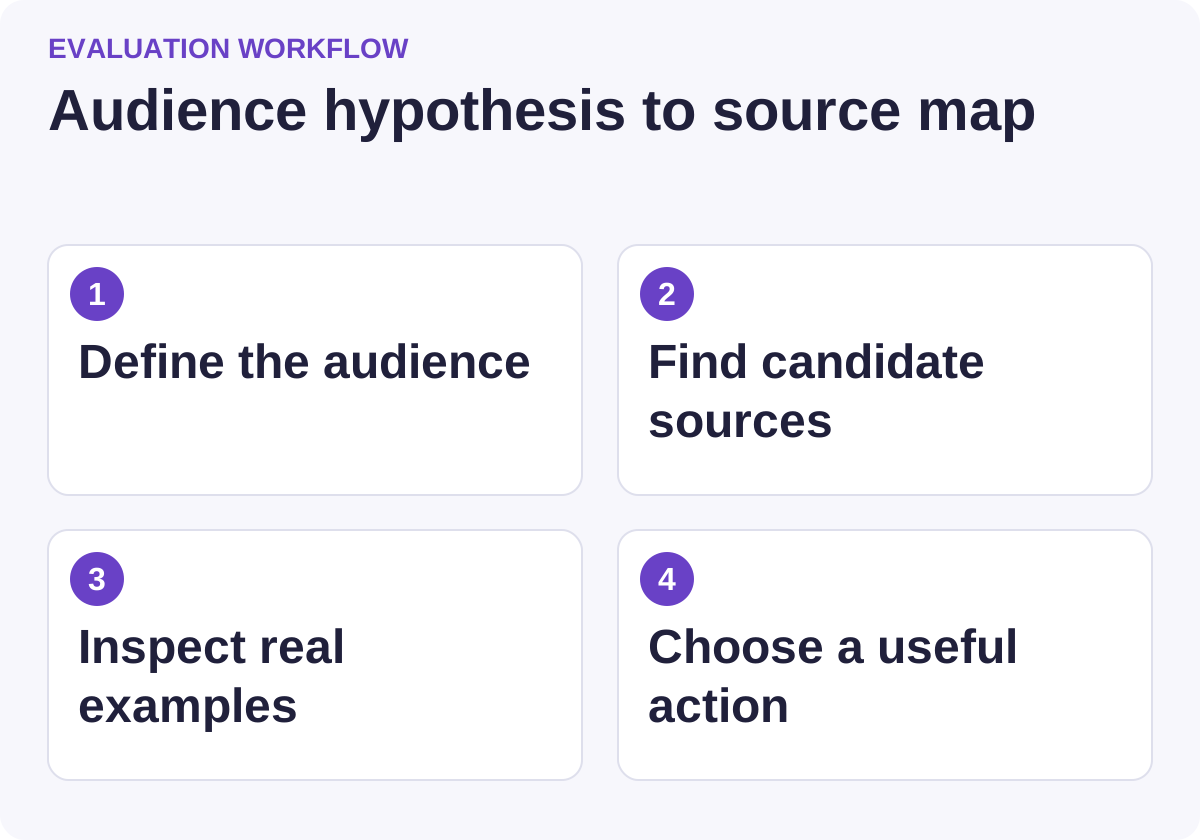
Use this workflow to compare candidates against the same requirements.
SparkToro: useful for discovering places you would not think to search
SparkToro lists audience research across website visitation, search keywords, demographics, Reddit subscriptions, and search and AI-tool usage. Its public example report shows how several of those dimensions can appear together.
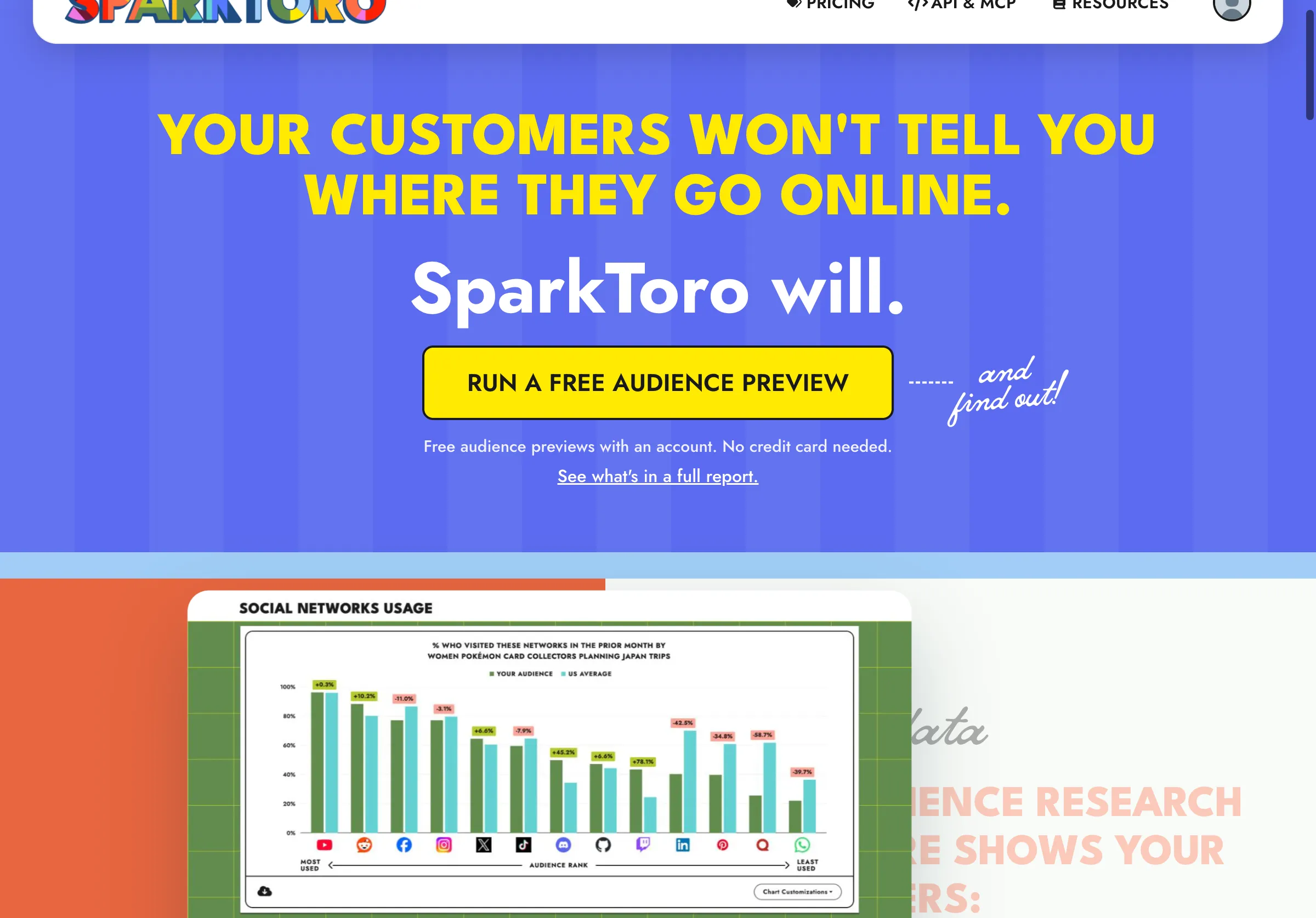
Public source page, captured November 2, 2026.
Choose it when you have a reasonably clear audience definition and need a broader shortlist than your team's familiar publications. Do not treat the output as a census of your buyers or as proof that a particular newsletter caused a sale.
The first trial should test audience definition. Compare a broad category with a narrower role or interest that better matches your customers. Inspect whether the results remain plausible and useful. If the audience is extremely small or poorly represented, a polished chart can still be a weak basis for spending.
Ask about the underlying population, geography, data recency and the meaning of each metric. Website visitation, affinity and subscriptions are different observations. Preserve those labels when you present the findings internally.
Brand24: useful for following the conversation, not defining the whole audience
Brand24 describes monitoring mentions across social media, news, blogs, forums, videos, podcasts and reviews, with filtering and analysis. This makes it relevant when you already know the concepts, products or problems you want to follow.
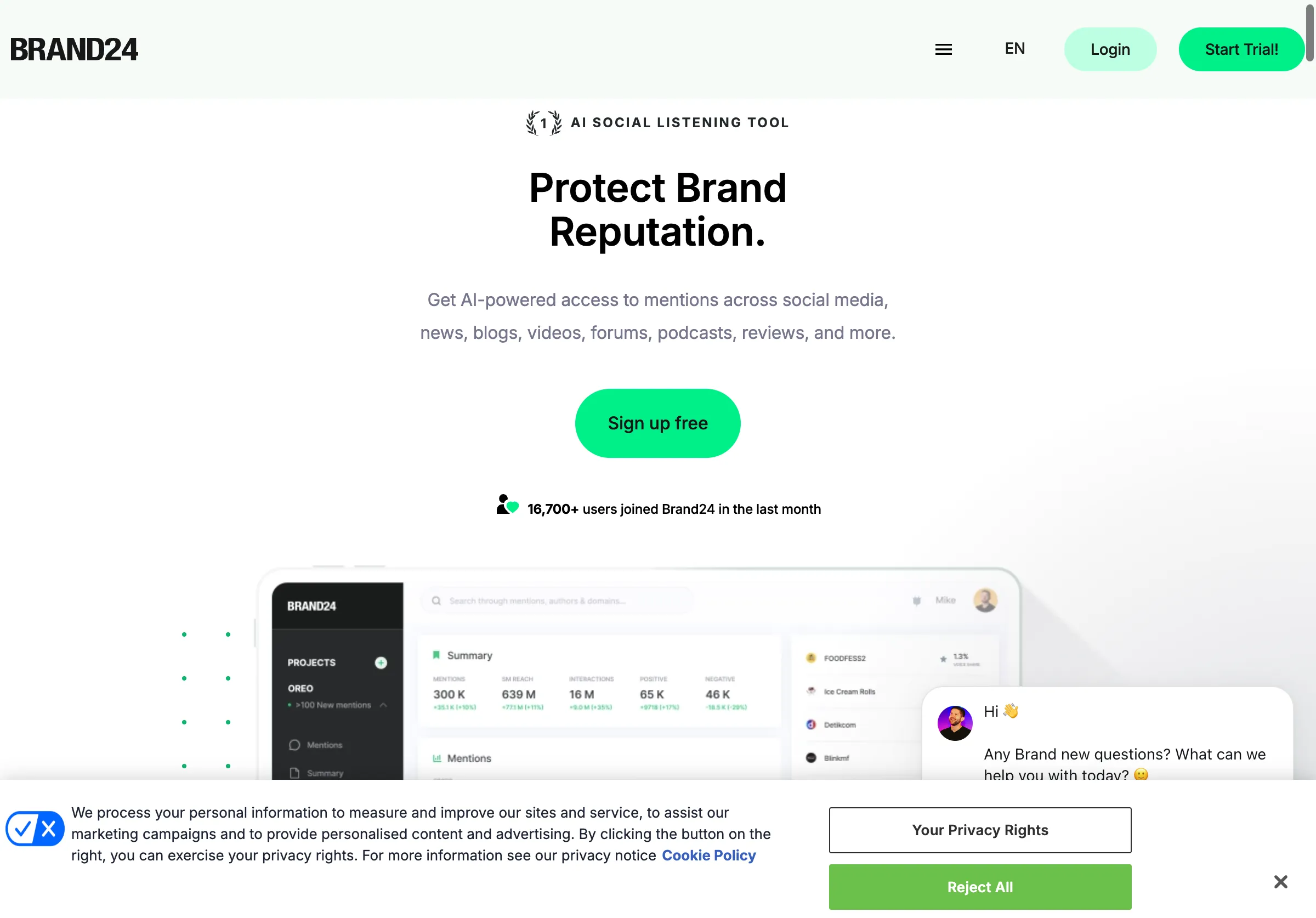
Public source page, captured November 2, 2026.
Choose it when the research question concerns current public discussion and you can refine a query. Do not assume that a quiet dashboard means people are not discussing the topic. Private communities, unsupported sources, historical limits and ambiguous terminology can all affect the results.
Start with a buyer problem rather than only a brand name. A workflow tool might monitor phrases about approval delays or maintaining technical content. Review actual mentions before accepting sentiment labels or estimated reach as useful evidence.
For the trial, mark each result as relevant, irrelevant, duplicate or uncertain. Preserve the original URL and enough context to understand the question. A summary without its source is difficult to audit and easy to overinterpret.
Customer interviews: useful for understanding the sequence
Interviews work best when you ask about a recent, concrete decision. “Where do you get industry news?” invites a different answer from “What did you open after you realized your current process would not work?” Both can be useful, but only the second begins reconstructing a buying journey.
Choose interviews when you need to understand why a source mattered, which alternatives were considered and what changed the buyer's confidence. Do not treat a handful of enthusiastic customers as representative of every prospect.
Ask participants to describe the sequence in their own words. With permission, they may show bookmarks, saved messages or a public page they remember. Avoid leading them toward the channels your team hopes to justify. Record uncertainty when they cannot remember a source.
Include different outcomes where practical: recent customers, lost opportunities and people who postponed the decision. Their research paths may differ. Report how participants were recruited and which groups are missing before turning observations into a channel strategy.
Manual research is the necessary finishing step
Whatever produced the shortlist, inspect the actual destination. A subreddit may discuss the right topic but prohibit promotional participation. A trade publication may serve practitioners while your product is bought by finance leaders. A podcast's broad audience can hide a very relevant episode.
Choose manual review when you need to qualify a manageable list. Do not substitute a domain-level label for reading representative pages. Keep examples of the exact discussions, articles or episodes that made the source relevant.
Our guide to publisher outreach tools covers what happens after a publication is qualified. Discovery is not permission to contact every author or insert a product into every conversation.
Build a source map with explicit evidence types
A source map should help the team act without overstating what the research proves. Use one row per destination and separate observations from decisions.
| Field | Example of what to record |
|---|---|
| Audience hypothesis | Operations leaders at small B2B software teams |
| Destination | A specific publication, community or show |
| Evidence type | Audience estimate, public mention or interview recollection |
| Relevant example | Canonical URL and short description |
| Buying stage | Learning the problem, comparing options or implementation |
| Proposed action | Read, interview, pitch, sponsor or decline |
| Limitation | Geography, sample, recency or access uncertainty |
The example audience is illustrative. Replace it with a definition your sales and customer teams recognize. If different teams mean different things by “our buyer,” resolve that before interpreting the tool output.
Add a confidence note that explains its basis. “Three recent interviewees independently named this resource” is more useful than an unexplained score of 87. Keep the original count and sample size visible.
Test usefulness with a small, repeatable exercise
Give each method the same audience brief and decision: choose five places worth investigating for a specific content initiative. Set a fixed research window and record the time spent. Do not score a tool merely on the number of destinations returned.
Evaluate novelty, relevance, evidence quality and actionability separately. A familiar publication can still be a strong choice; an obscure source is not automatically valuable. Check whether a researcher can explain why each destination belongs on the list.
Then have a second person review the shortlist without seeing the first person's recommendation. Disagreements often reveal a vague audience definition or a weak link between a source and the buying task. Resolve those before buying sponsorships or committing months of content work.
This is also the point to check current access and participation rules. An interesting community may be valuable for listening while being unsuitable for company participation.
Compare the cost of a useful decision
For SparkToro, confirm query allowances, report access and the audience coverage relevant to your market. For Brand24, confirm keyword or project limits, source coverage, history and export needs. For interviews, budget recruiting, incentives where appropriate, scheduling, analysis and participant permissions.
Compare the total effort required to produce a defensible shortlist. A cheaper subscription can be expensive if the results need extensive manual cleanup. An interview program can be wasteful if it repeatedly asks broad questions that never inform a decision.
Start with one decision and a bounded research cycle. Expand the system only when the findings repeatedly change what your team does.
Connect audience research with AI-source research
Audience research asks where people seek information. Parse can help investigate which sources appear in the AI answers you monitor. Those sets may overlap, but they should not be assumed identical.
Keep the two evidence types separate in the source map. A publication cited by an AI answer is not necessarily popular with your exact buyers; a trusted private community may never appear as a public citation.
Bring the audience definition, the decision you need to make and the evidence you already have.