Best tools for finding publishers behind AI recommendations
Compare BuzzStream, Respona and a spreadsheet workflow for researching relevant publishers, preserving context and managing careful editorial outreach.
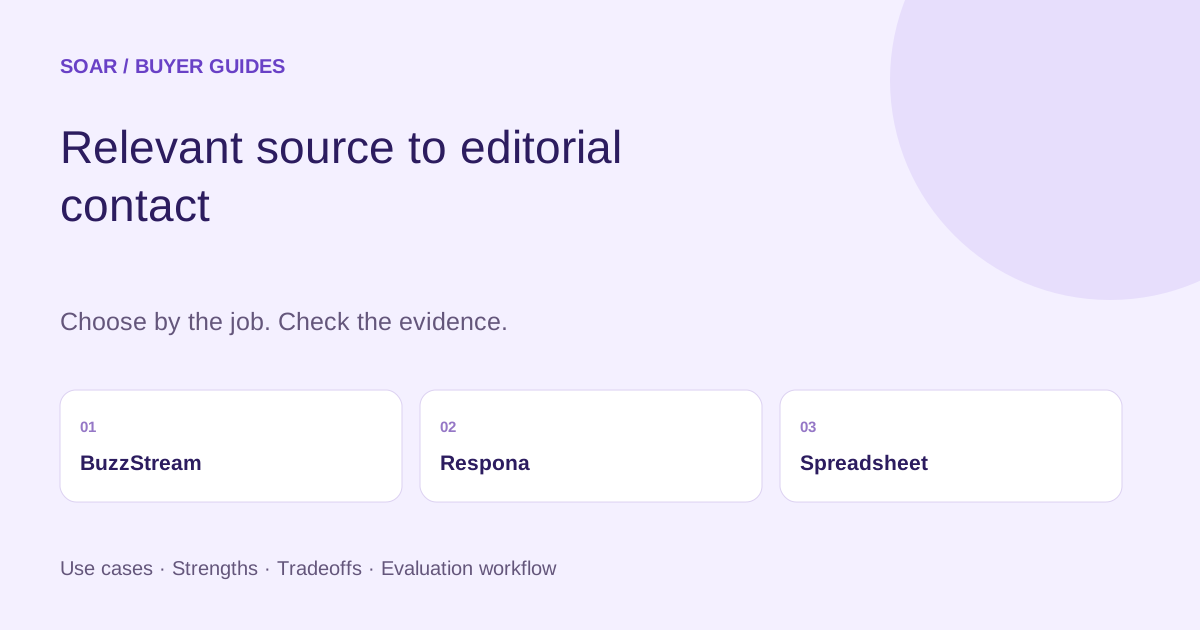
The best publisher-outreach tool preserves why a particular editor might care. BuzzStream is a strong shortlist for an in-house research and relationship workflow. A spreadsheet can be better for a small, carefully selected campaign. Respona needs a separate evaluation because its current homepage emphasizes managed placements, while other pages still describe outreach software. Confirm which product you are actually buying.
An AI citation is a research lead. It is not permission to pitch, evidence that a page accepts contributions or a promise that a placement will change future answers. Start by reading the publication and identifying a useful, relevant contribution.
Which approach should your team evaluate?
Separate software for managing your own relationships from a service selling placement execution. They involve different responsibilities and should not share an unexplained “best outreach tool” ranking.
| Approach | Best fit | Useful strength | Main diligence question |
|---|---|---|---|
| BuzzStream | A team researching and contacting publishers itself | Research, contact history and coordinated outreach | Can the team retain page-specific context and avoid duplicates? |
| Respona | Teams evaluating either its advertised software or managed service | Public offerings cover outreach and placement execution | Which offering is available, and who controls publisher selection and sending? |
| Spreadsheet and existing inbox | A small, selective campaign | Transparent records with little setup | Can the team maintain ownership, suppression and follow-up history? |
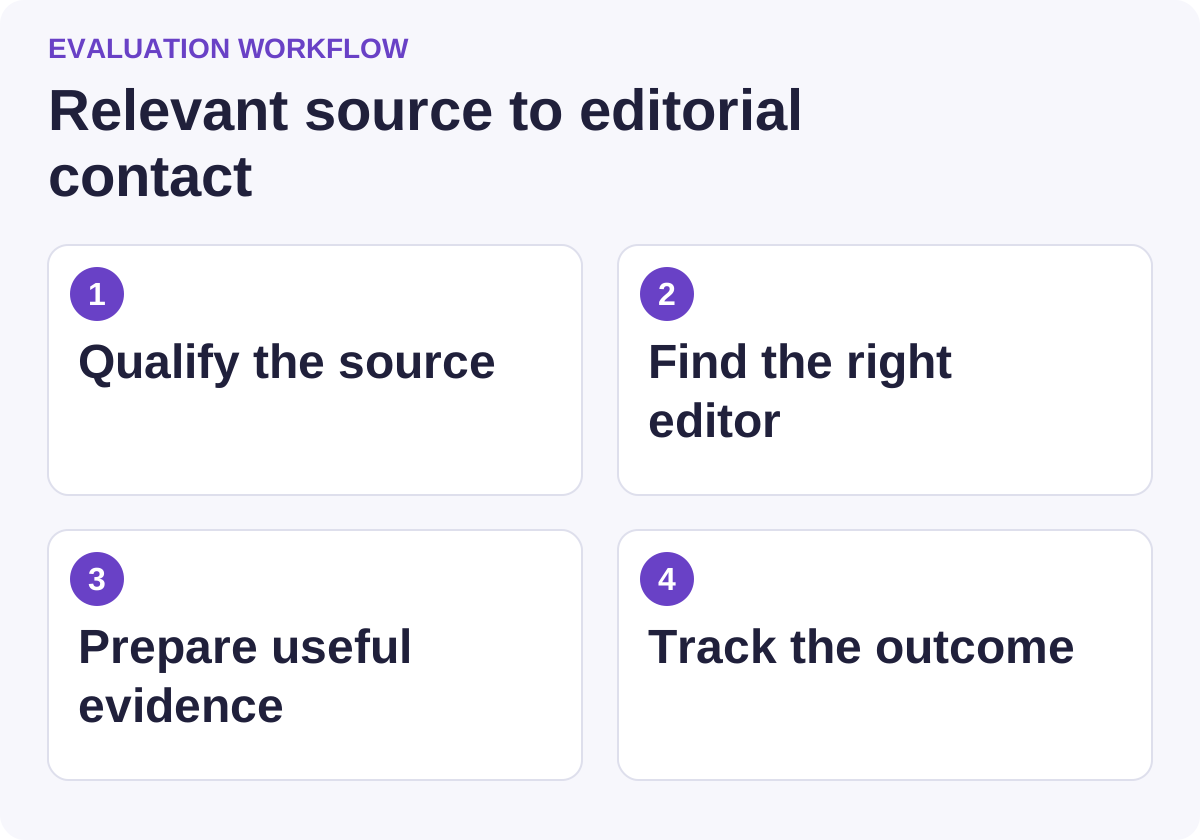
Use this workflow to compare candidates against the same requirements.
Research the page before looking for an address
Record the exact page, the relevant passage and the buying question it addresses. Then identify what a reader would gain from an update: a corrected factual statement, a useful dataset, an expert explanation or a genuinely missing option. “An AI cited you” is rarely sufficient editorial value.
Read the publication's about, contact and contributor pages. A named writer may be a freelancer who cannot update the article. A general editorial address may be more appropriate than an executive's email. Some sources do not accept pitches at all.
Create an explicit no-contact category. It can include irrelevant publications, pages without a sensible contribution, authors who decline and sources where commercial contact would be inappropriate. A good tool should preserve those decisions instead of resurfacing the same prospect in the next campaign.
Parse, a related product to Soar, can help identify cited sources in observed AI answers. It supplies research context, not a list of people who have agreed to receive outreach. Keep the source evidence attached to the record when you move into a relationship-management tool.
When should you choose BuzzStream?
BuzzStream describes an outreach workflow spanning research, contact discovery, email and relationship management. Its management product page is particularly relevant to a team that needs shared context and visibility into past conversations.

Public source page, captured November 2, 2026.
Choose it when several people work on publisher relationships and the cost of duplicate or context-free outreach is rising. Do not buy it simply to increase sending volume. A tool can coordinate a poor prospect list as efficiently as a good one.
Evaluate the record, not only the email editor. Can a colleague see the exact article, why the publication was selected, the person contacted, the proposed contribution and any previous refusal? Can the team distinguish one editor from several people at the same domain?
In the trial, have two team members add the same publisher through different routes. Check how the system surfaces the overlap before anyone sends. Then inspect whether a reply stops the relevant follow-up. These are meaningful relationship controls; a larger template library is secondary for a selective editorial campaign.
How should you evaluate Respona's current offering?
Respona's public pages describe more than one buying path. Its homepage emphasizes done-for-you placements. Its blogger-outreach page describes contact finding, personalization and follow-up software. Do not assume an older software review describes the current commercial offer.

Public source page, captured November 2, 2026.
If you want software, confirm that it is available as the product you expect, with your own prospect selection, sending identity, approval and export controls. Ask for the actual workflow on a sample publisher record. If you want a service, evaluate the service contract instead: publisher approval, editorial relevance, placement disclosure, link treatment, removal terms and reporting.
Choose Respona only after that distinction is settled. Do not substitute a purchased placement for an independent editorial recommendation in your reporting. Nor should a provider's claim about AI visibility become a promise of future citations in your internal business case.
For a small campaign whose purpose is a direct relationship with a specific publication, the in-house path may fit better. For delegated execution, the meaningful question is what the provider will do, under whose identity and with what review rights. The product name alone cannot answer it.
When is a spreadsheet the better tool?
A spreadsheet and an existing inbox can be sufficient for a small campaign with a single owner. The advantages are visibility and flexibility: the team can inspect every decision without learning a specialized system. The disadvantages are manual updates and weaker coordination as the campaign grows.
Use separate columns for publication, page URL, contact, role evidence, editorial fit, proposed contribution, owner, last contact, reply, next action and do-not-contact status. Preserve a link to the actual conversation instead of pasting only a summary.
Choose this route when the list is small enough to review one record at a time. Do not choose it if multiple people send from separate inboxes and nobody can reliably see the latest state. At that point the “free” tool is creating relationship risk.
Keep publication and person records distinct. An editor can leave a publication; a publication can have several relevant editors. A single “name and email” cell makes those changes difficult to represent. The data model matters even before you buy a CRM.
Compare tools with the same publisher list
Build a sample list from public pages you have read. Include a clear author contact, a publication with only a general editorial address, a freelancer byline, two pages from the same domain and one source that is inappropriate to pitch. Do not send anything during the evaluation.
For each option, research the responsible person and retain the evidence supporting that choice. Record uncertainty rather than forcing every row into “ready.” An unknown contact is a valid result; a confident but wrong person is an expensive mistake.
Then ask a second reviewer to take over the records. Can they explain why each publication belongs, what is being offered and what would make the pitch inappropriate? If they must reopen every page from scratch, the tool is not preserving enough context.
Score concrete outcomes: correct role, source retained, duplicate found, refusal preserved and next action clear. Do not rank tools by the number of addresses returned. A small list of relevant, well-understood contacts is the useful output for this job.
Preserve the context that makes a pitch personal
Personalization should explain the connection between the publication's work and your contribution. It is not a sentence saying you enjoyed an article before making an unrelated request. Store the passage or question that makes the contribution relevant, plus the supporting material you can actually provide.
A useful record might say: “The comparison treats all integrations as automatic; our public setup guide documents a manual exception.” That supports a factual correction. Another might say: “The article lacks data on implementation time; we have a method and dataset with limitations.” That supports an editorial offer.
Keep commercial relationships visible. If a contribution involves payment, a reciprocal arrangement or another material benefit, it should not be represented as an independent endorsement. Evaluate whether the tool can preserve those terms and the final published URL.
The expert-led content workflow guide covers creating material worth offering. Outreach becomes easier to judge when the proposed contribution already exists and a reader can inspect it.
Design follow-ups around human responses
A follow-up should have a reason and a stopping rule. Record whether the editor replied, declined, referred you elsewhere or asked for more information. A scheduled sequence that ignores those events can turn a reasonable initial message into a poor interaction.
In a trial, use internal test recipients to check reply handling, owner changes and suppression. Do not send test campaigns to real publishers. Verify that a colleague can see a refusal before starting a different campaign to the same person.
Keep the sending identity accurate. The editor should understand who is contacting them and which organization the person represents. Automation does not justify impersonation or a false claim of having read the recipient's work.
For low-volume editorial outreach, a manual final review is usually inexpensive relative to the value of the relationship. The software should make that review easier by showing the page context and conversation history together, rather than hiding them behind a bulk-send screen.
Measure outcomes without inflating them
Track the result that actually occurred. A reply, an agreed interview, a published research citation and a product recommendation are different outcomes. Keep them separate in the campaign report. A placement URL is evidence of publication, not proof of traffic or AI recommendation impact.
Check the published page yourself. Confirm the wording, destination URL, attribution and any disclosure. Record the date and the evidence. If the article changes later, update the relationship record rather than relying indefinitely on the original promise.
Cost comparisons should include prospect research, contact verification, software seats, writing, follow-up and publication review. For managed services, include the actual deliverable and what happens if it is removed or unsuitable. A low cost per email is not a useful success metric for a selective campaign.
Our guide to content distribution across Reddit, Quora and AI search explains the wider publishing context. Choose the outreach system that preserves relevant evidence and helps your team treat publishers as people with editorial judgment.