Best tools for refreshing outdated B2B content
Compare AirOps, Surfer, Clearscope and an editor-led workflow for refreshing B2B content while preserving expert knowledge and correcting stale claims.
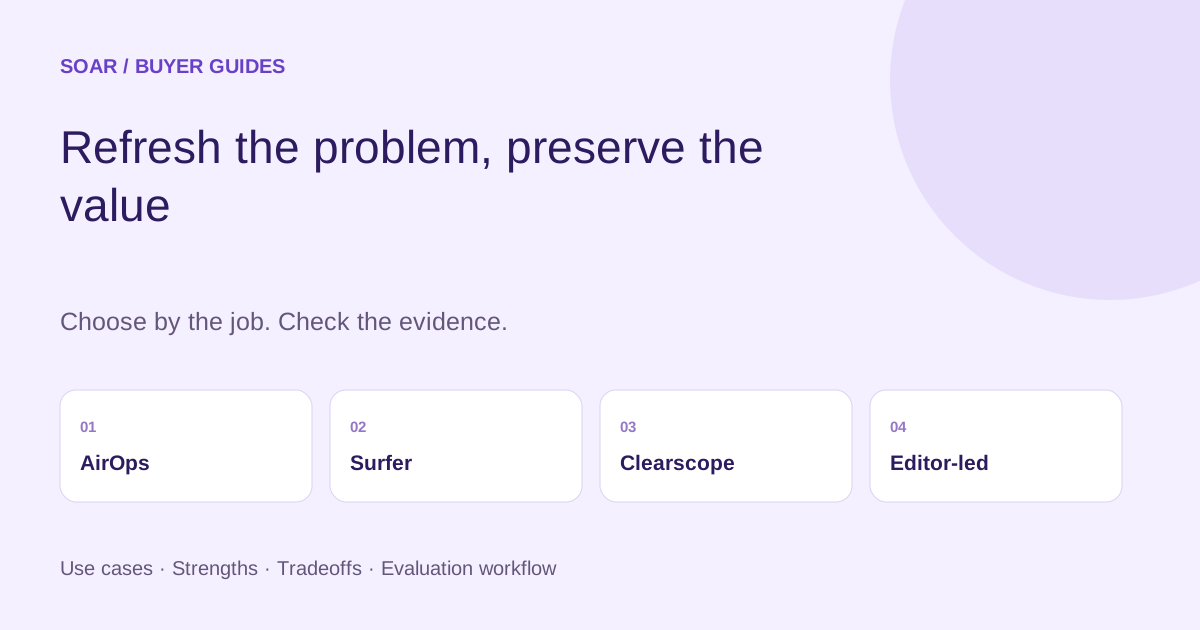
Choose AirOps when you need to coordinate a repeatable refresh workflow across research, drafting and review. Evaluate Surfer when search-performance signals and editor guidance are central to prioritization. Consider Clearscope when content monitoring and editorial guidance belong in one workflow. Keep an editor-led process when the library is small or the content depends heavily on specialized expertise.
A refresh should repair a specific problem. It may need a corrected price, a new limitation, a clearer example or a better answer to the reader's question. Rewriting the entire page can remove the very expertise that made it useful.
Which approach fits the maintenance problem?
Separate deciding what needs attention from approving what changes. A performance signal is not a factual verdict.
| Approach | Strongest starting fit | What to inspect | Main risk |
|---|---|---|---|
| AirOps | Coordinating a repeatable content operation | Source inputs, workflow steps and human review | Automation can repeat weak assumptions at scale |
| Surfer | Search-informed prioritization and editing | Content Audit and Content Editor handoff | A higher content score does not prove factual accuracy |
| Clearscope | Monitoring and maintaining an existing library | Page monitoring and editor guidance | Optimization suggestions can obscure original expertise |
| Editor-led review | A small or highly specialized library | Claim checks, expert review and focused edits | Manual prioritization and recurring review take time |
Disclosure: Parse is a related product from our team.
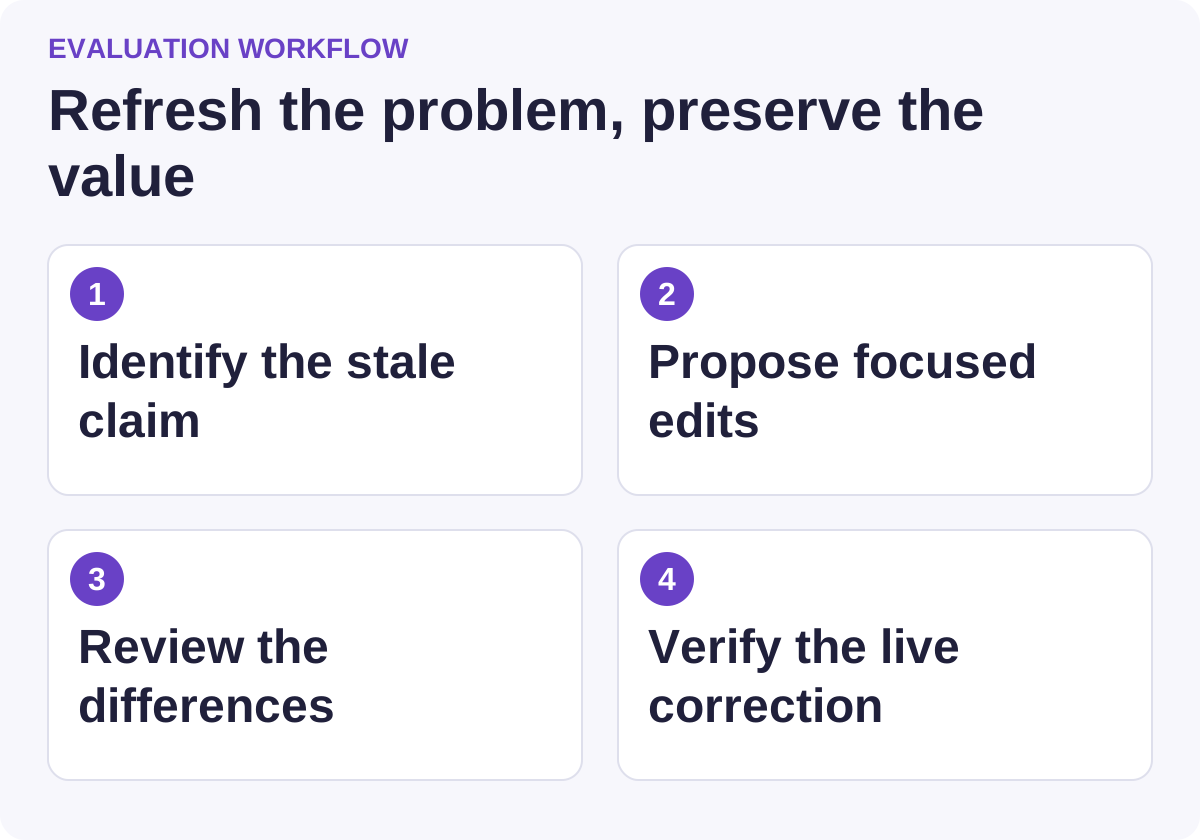
Use this workflow to compare candidates against the same requirements.
AirOps: evaluate the workflow and its stopping points
AirOps describes a platform for researching, publishing and refreshing content with workflow and governance capabilities. Its Human Review documentation explains a step that pauses execution for review.
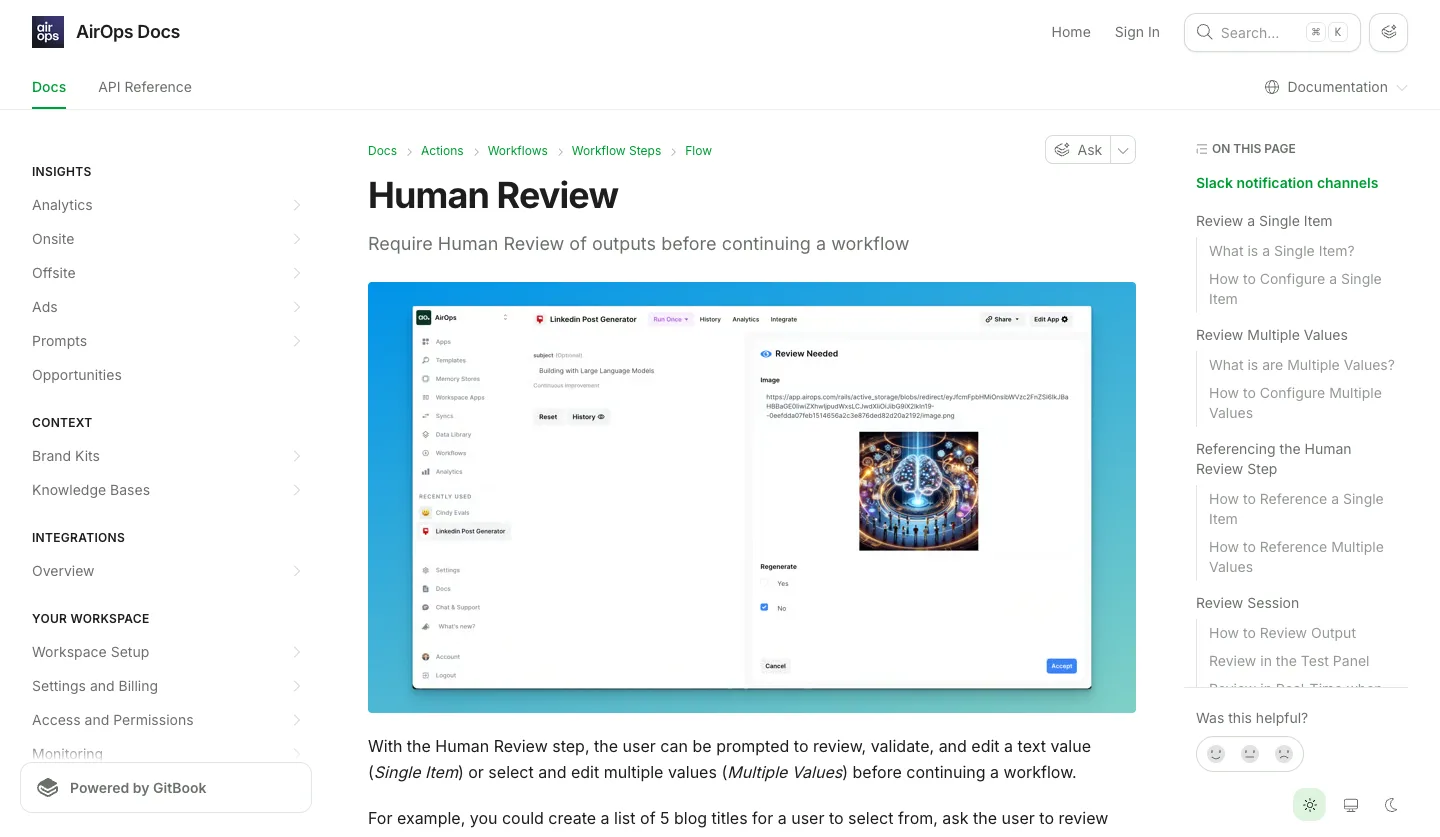
Public source page, captured November 2, 2026.
Choose it when the refresh process has several recurring stages and enough volume to justify configuration. Do not assume a workflow is reliable because it runs without errors. It can successfully produce an inaccurate update if its sources or instructions are weak.
In a trial, require the workflow to identify the specific claims it proposes to change and retain their sources. Put review before publication. Ask the editor to reject one unsupported change and confirm that the workflow handles the rejection cleanly.
This is a different purchase from simply generating new articles. Our expert-led content workflow guide covers production; a maintenance workflow needs to preserve useful existing material and explain why each proposed change is necessary.
Surfer: evaluate prioritization without outsourcing judgment to a score
Surfer Content Audit describes connecting Search Console, identifying opportunities and moving pages into Content Editor. Its Content Editor page describes importing existing content and applying editing guidance.
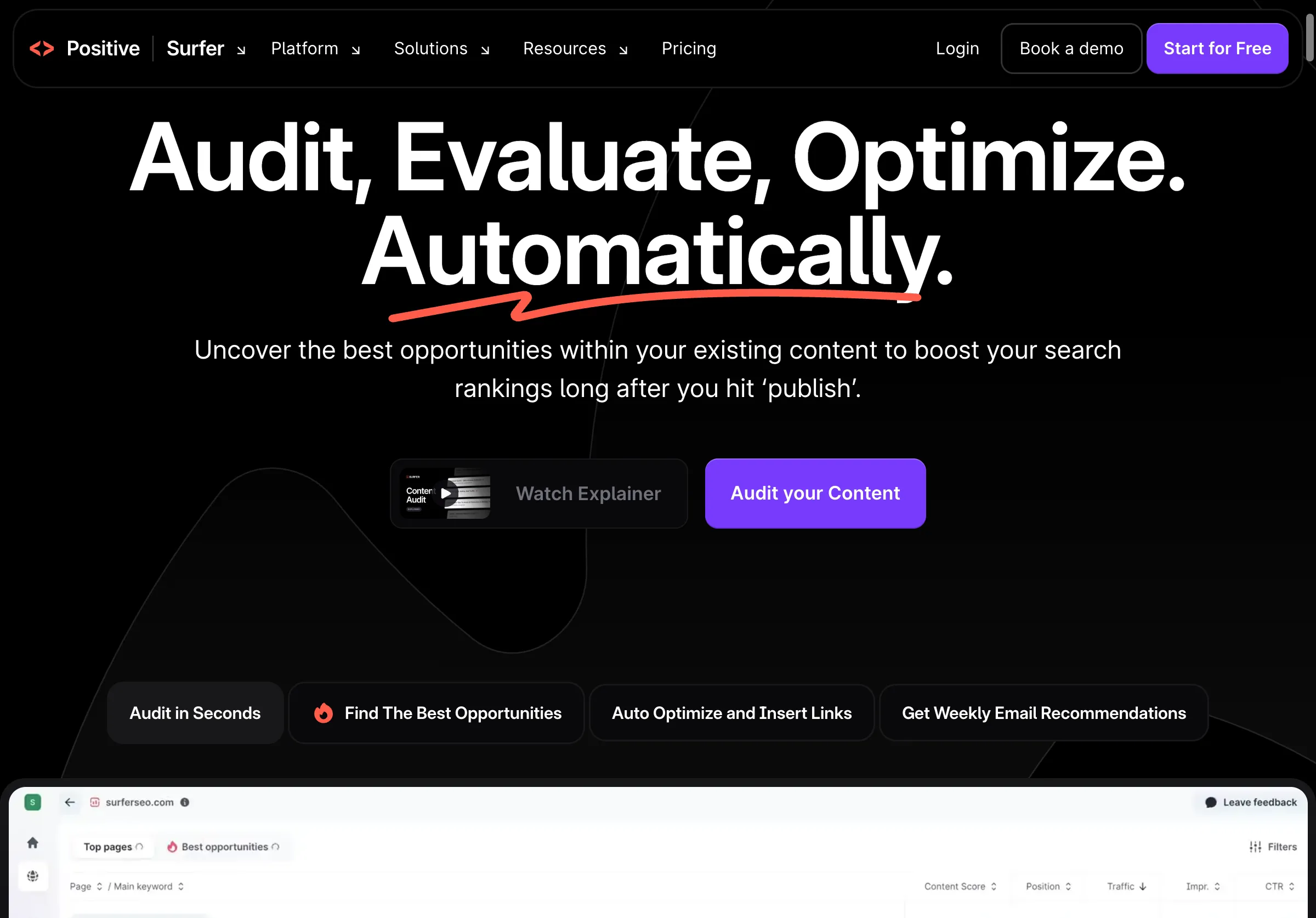
Public source page, captured November 2, 2026.
Choose it when search-performance data helps your team decide which pages deserve review. Do not treat a declining click count as proof that the prose is wrong or that a rewrite is the correct remedy. Demand, competitors, search presentation and technical changes can also affect performance.
In a trial, inspect a page with a factual error and another with accurate but specialized terminology. Ask whether the proposed edits resolve the first problem without flattening the second into generic language.
Keep automated additions as suggestions until checked. Adding related terms can improve coverage in some contexts, but it can also introduce a claim the expert never made. The final article should answer the reader's question, not display every suggested phrase.
Clearscope: evaluate monitoring and the return to the editor
Clearscope describes a content lifecycle spanning discovery, tracking, writing and monitoring. Its current monitoring description includes Search Console data, page grades and views for finding content that may need attention.
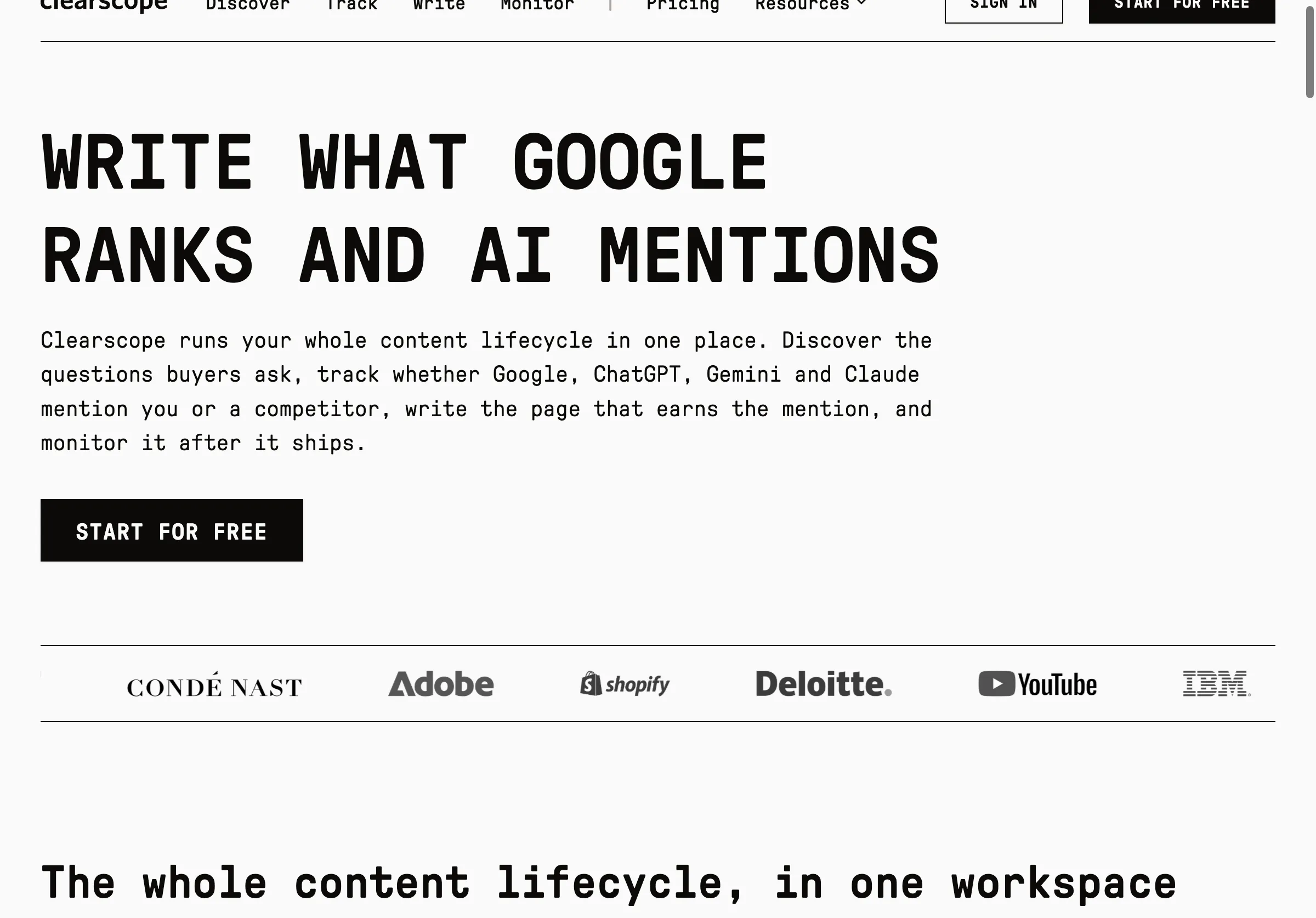
Public source page, captured November 2, 2026.
Choose it when the team wants to connect the existing library with a recurring editorial review. Do not assume the product's broader AI-visibility features are the same as a factual maintenance system. Confirm which modules and allowances are included in the intended plan.
For the trial, take one monitored page into the editor and identify exactly what changes are proposed. Can the editor preserve a useful original example while correcting a stale claim? Can the team distinguish a performance recommendation from a verified factual correction?
A good refresh process should leave the article more accurate and easier to use. A higher grade alone is not enough to establish either outcome.
Editor-led maintenance: often the best starting point
Choose an editor-led process when the library is small, the subject is technical or the value rests on original experience. A simple inventory and review calendar can be enough if responsibility is clear.
Do not use “manual” to mean informal. Keep an article owner, source links, last factual review, known issues and the next review trigger. Product changes, broken instructions and obsolete recommendations deserve attention even when traffic is stable.
An editor can make a narrow correction without disturbing a strong explanation. That is especially valuable for pages with expert quotations, tested procedures or distinctive examples that an automated rewrite might dilute.
Add software when a specific repeated task becomes expensive: monitoring, source collection, coordinating review or checking a large library. Keep the editorial decision accountable regardless of the tool.
Build a refresh brief before editing
State the problem, evidence and allowed scope. For example: “The article describes an integration as beta, but the official documentation now lists it as generally available. Update the affected recommendation and screenshot, preserving the original setup explanation.”
Identify what should remain: original research, useful examples, accurate quotations and explanations that still answer the question. A refresh is not an obligation to change every paragraph.
Separate three kinds of work. Factual corrections repair wrong or stale statements. Coverage improvements answer an important missing question. Presentation improvements make existing information easier to use. Each needs a different justification and reviewer.
Use one deliberately outdated article for the trial
Create a fictional article fixture so every tool sees the same problems. Do not publish its invented facts as research.
| Fixture element | Desired editorial action |
|---|---|
| Old plan price | Verify the current source and correct it |
| Feature described as unavailable | Check scope before changing the recommendation |
| Broken documentation link | Find the canonical replacement |
| Valuable expert example | Preserve its meaning and attribution |
| Unsupported performance promise | Remove or substantiate it |
| Accurate but dense paragraph | Simplify without dropping conditions |
| Screenshot of an old interface | Replace or label it appropriately |
Ask each workflow for a proposed change list before a rewritten draft. Score the result on corrected errors, unsupported additions, preserved expertise and review time. A tool that makes fewer edits may be better if those edits solve the actual problem.
Keep the original version and inspect the diff. Reading only the polished final draft can hide the loss of a qualification, quotation or useful example.
Review the whole page after a narrow edit
A single factual change can affect the summary table, introduction, recommendation and CTA. Search for repeated claims and update them consistently. Check linked articles that reuse the same fact if they are in your maintenance scope.
Then read the page as a new visitor. Does the quick answer match the detailed sections? Are “choose this when” and “don't choose this when” still accurate? Does an updated screenshot support the surrounding instructions?
Verify the live page after publication. Confirm the actual text, images, links and updated date. A saved draft or successful content API response is not the same as a reader seeing the correction.
Measure maintenance quality before traffic impact
Track time to correct a known issue, unsupported additions caught in review, post-publication corrections and the share of priority pages with a current owner. These measures describe the maintenance process directly.
Traffic and visibility can be useful outcomes, but they require their own context. Record the publication date and the changes made, then observe the relevant metrics without claiming causation from a simple before-and-after chart.
For external AI-answer research, Parse can help inspect monitored descriptions and source evidence. A refreshed page does not guarantee a new citation or recommendation.
Buy against the library you will actually maintain
Compare article volume, review frequency, users, workflow runs, monitored pages and integrations. Include editor and expert time. Confirm whether automation, publishing and monitoring belong to the quoted plan.
Start with a small representative batch: one factual correction, one missing-answer improvement and one readability edit. The best tool is the one that helps the team make those changes accurately and repeatably.
Bring the pages readers rely on and the claims most likely to have changed.