Best tools for keeping comparison pages accurate
Compare Crayon, Klue, Kompyte and a lightweight research workflow for spotting competitor changes, checking sources and updating public comparison pages.
Choose Crayon, Klue or Kompyte when competitor research already supports a recurring product-marketing and sales program. Choose a lightweight research workflow when you maintain a small number of public comparison pages. In either case, the important handoff is from a detected change to a sourced, approved correction. An internal battlecard is not automatically suitable for publication.
A comparison can become misleading without its author changing a word. A competitor introduces a free plan, changes a limit or adds the integration your article says it lacks. The buyer needs the current answer, including the cases where the competing product is a better fit.
Which approach fits your comparison library?
The tools below help organize competitive information. The final editorial recommendation depends on what you verify and publish.
| Approach | Choose it when | Main strength to evaluate | Main limitation |
|---|---|---|---|
| Crayon | Competitive intelligence feeds several sales and marketing assets | Monitoring, analysis and refreshing competitive content | Generated updates need source and scope checks |
| Klue | Research must combine market signals with buyer and deal context | Competitive enablement alongside win-loss research | Internal deal evidence may not be publishable |
| Kompyte | You want tracked competitor changes feeding battlecards | Automated collection and filtering | Noise reduction does not establish a claim's truth |
| Lightweight research | A named editor owns a manageable page list | Direct sources and explicit review dates | Manual coverage can lapse without reminders |
Disclosure: Parse is a related product from our team.
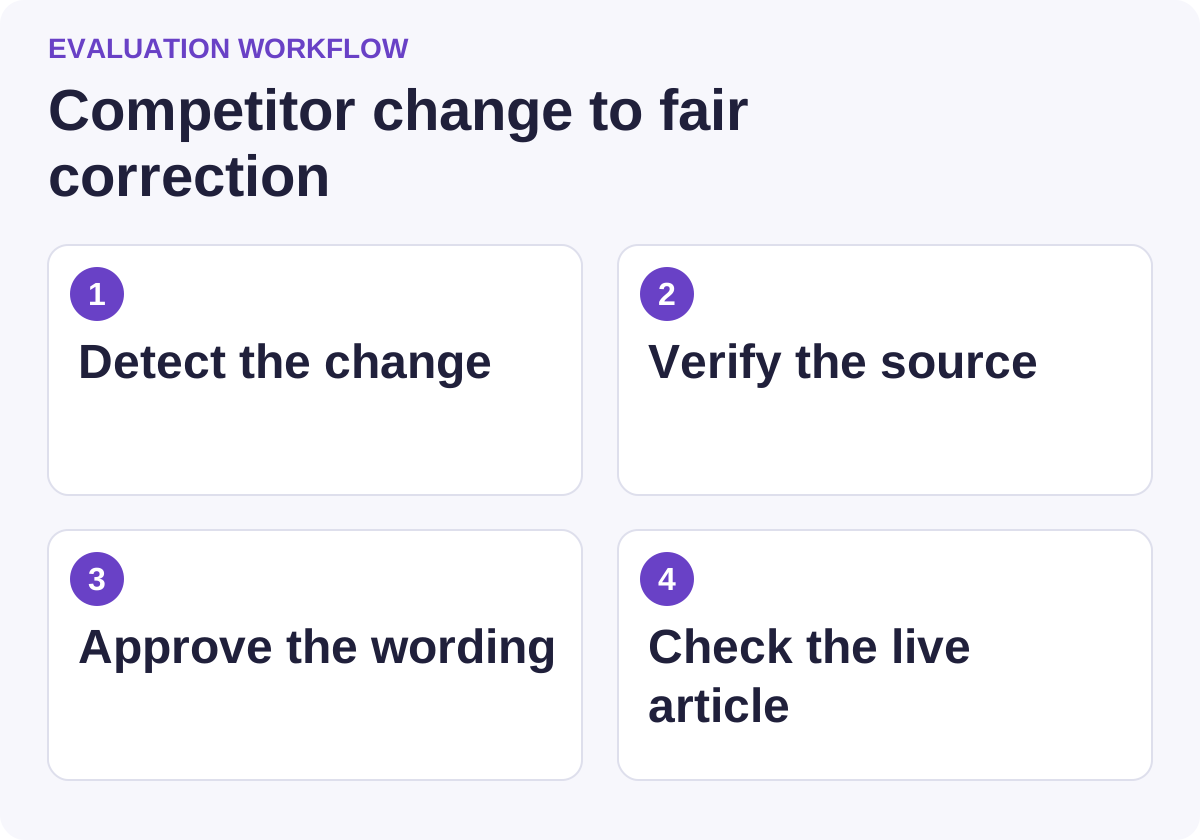
Use this workflow to compare candidates against the same requirements.
Crayon: evaluate the path from signal to maintained content
Crayon Sparks describes analysis of external competitor changes and internal information, plus creating and updating competitive assets. That makes it relevant when one change must inform battlecards, sales responses and marketing content.

Public source page, captured November 2, 2026.
Choose Crayon when the research has several downstream owners and maintaining a shared intelligence program justifies the setup. Do not buy it solely to refresh three comparison articles if nobody will curate the inputs or act on the updates.
For a trial, ask the vendor to show the underlying source for a suggested correction. Can an editor tell whether a pricing statement comes from a current pricing page, a dated announcement or a rep's note? Can the team retain the evidence after the source changes again?
The public article should state the useful fact and its conditions. An internal note such as “we win on implementation” needs much more work before it becomes an honest comparison: implementation for whom, with which requirements, and based on what evidence?
Klue: useful when buyer context changes the recommendation
Klue presents competitive intelligence and win-loss research in one offering. Its current product lineup includes competitive collection and curation, deal support, and several ways of gathering buyer feedback.

Public source page, captured November 2, 2026.
Choose it when your team needs to understand both what competitors changed and why buyers choose differently. Do not treat private interview findings as publicly attributable quotations or assume every buyer's experience represents the whole market.
A product can offer an integration and still be a poor fit for a particular implementation. Buyer context helps the editor ask better questions, but the public claim still needs a defensible source. Separate “the integration is documented” from “our interviewed buyers found setup difficult.” The latter needs permission, methodology and careful qualification if published.
In a demonstration, follow one item from its original evidence into a proposed article update. Ask who can approve the wording and whether the supporting material can be shared with the editor without exposing confidential deal information.
Kompyte: evaluate filtering and ownership together
Kompyte describes automated tracking across competitor sources and AI filtering, with information delivered through sales battlecards. It is a sensible candidate when the team spends too much time collecting changes and too little time deciding which matter.
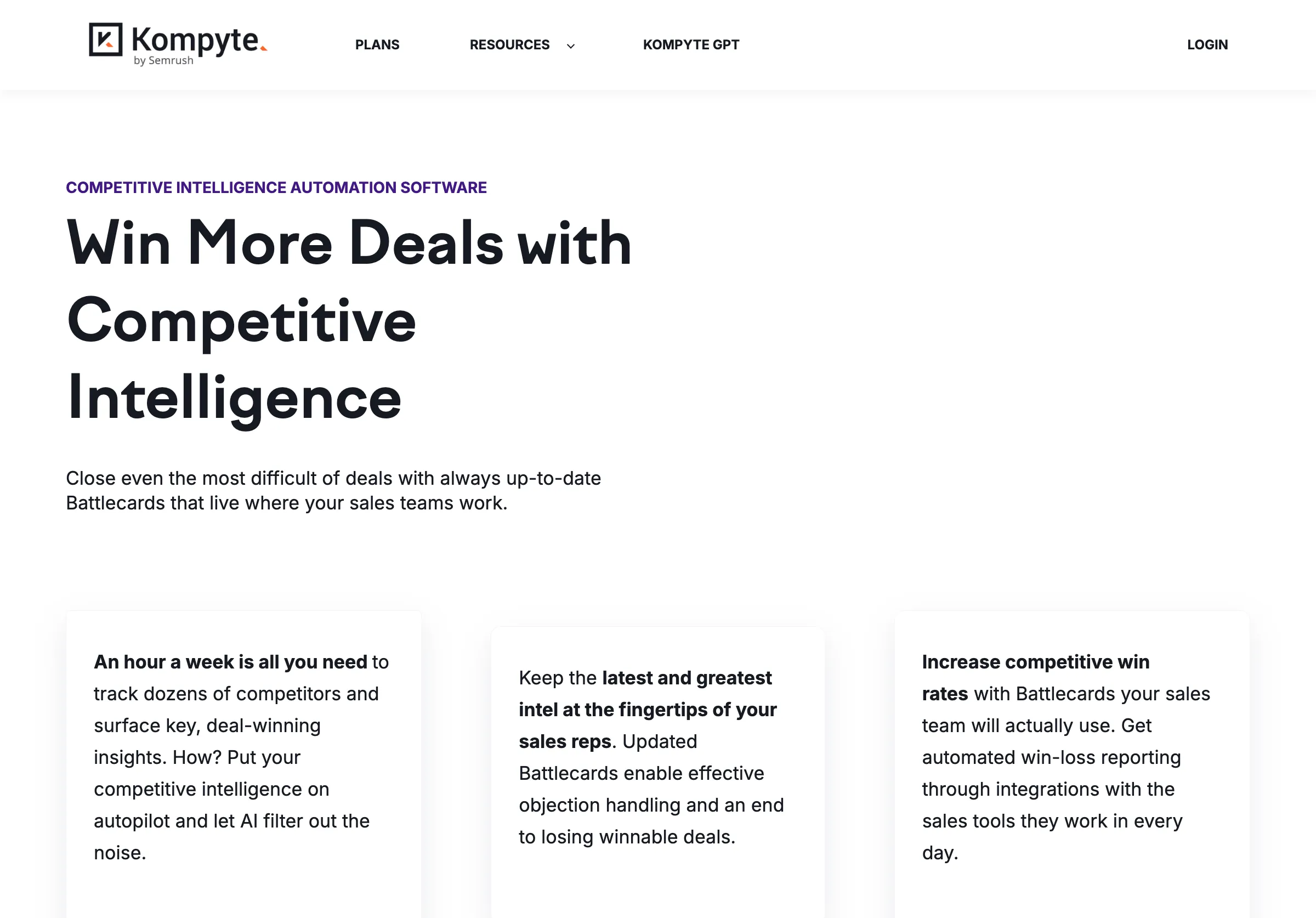
Public source page, captured November 2, 2026.
Choose it when repeated competitor monitoring serves an ongoing sales and marketing workflow. Do not equate fewer alerts with complete coverage. A filter that suppresses harmless layout changes may also miss a small but consequential qualification in a pricing footnote.
Ask to inspect an unfiltered change alongside its summary. Can the editor see the original passage, date and destination? Can a meaningful change be assigned to someone, marked reviewed and connected to the public article it affects? Confirm which parts are native capabilities and which require your own task system.
The buying decision should include the time needed to maintain sources and review alerts. A collection engine without an editorial owner creates a larger backlog, not a more accurate library.
A lightweight workflow can be the better purchase
For a small library, keep a claim register in a spreadsheet or existing project tool. Give each consequential statement its own row: article URL, claim, official source, source date, plan or region, owner, last review and next review.
Choose this approach when the number of claims is small enough for a real person to review regularly. Do not choose it if “someone checks occasionally” is the entire maintenance plan. Add calendar reminders and a correction intake route from sales and support.
A page monitor can complement the register. Our guide to monitoring recommendation pages explains the difference between meaningful changes and page noise. Monitoring tells you where to investigate; the claim register tells you what your own article might now get wrong.
Run the same six-change exercise
Use a page you control and fictional product facts. Record the original page, then introduce changes at known times. This avoids editing a competitor's site or pretending a product demo is a production benchmark.
| Deliberate change | Correct editorial response |
|---|---|
| Navigation color changes | No article update |
| A paid feature becomes available on a free plan | Check eligibility and revise the comparison |
| A price changes for annual billing only | Preserve the billing condition |
| An integration moves from beta to general availability | Verify scope and update the status |
| A feature disappears from a marketing page | Investigate; absence alone does not prove removal |
| A limitation is added in a footnote | Update the affected recommendation |
Score the workflow on evidence retained, missed meaningful changes, irrelevant alerts and minutes of editorial review. Keep these dimensions separate. A tool that detects every tiny change may create more work than a slower, well-targeted process.
For each alert, record the earliest confirmed detection time and the actual publication time of your correction. The gap between them reveals whether the bottleneck is collection, review or publishing. Do not report an alert timestamp as a corrected-page timestamp.
Turn a finding into a fair comparison
Start with the affected sentence. Replace a broad assertion with a specific, sourced one. Instead of “Tool B has no team controls,” write the verified boundary: which controls, on which plan, at what review date. If the source is unclear, remove the categorical statement until it can be resolved.
Then revisit the recommendation. A new integration may change who should buy the product; a cosmetic redesign probably does not. Check the summary table, feature section, conclusion and any reused sales copy for the same stale claim.
Give competitors a meaningful “choose this when” case. Accuracy includes acknowledging their strengths. A page that always concludes your own product is best becomes less useful as soon as a reader recognizes an exception you omitted.
Keep an internal correction record with the old wording, new wording, evidence and approving editor. The public page needs an honest updated date and clear current text, not a long operational log.
Compare the cost of maintaining a correct recommendation
Request a quote against the same competitor set, users, source volume, history needs and integrations. Ask about onboarding, contract duration and exports. Public positioning alone is insufficient for a reliable like-for-like price comparison.
Include editorial time in the budget. Estimate recurring source review, alert triage, fact checking and publication. For a small library, that labor may still cost less than a full competitive-intelligence platform. For a large organization, shared intelligence can avoid repeated research across teams.
Before committing, ask the team to complete one correction from alert to live page. Purchase the workflow that makes that process repeatable and accountable.
Connect external visibility to the research queue
Parse can help investigate which competitors and sources appear in the AI answers you monitor. That can identify comparisons worth reviewing. It does not prove a competitor's feature claim or replace primary-source research.
For ongoing maintenance after the first correction, see our B2B content refresh guide. It covers preserving useful expertise while repairing stale claims.
Start with the claims buyers rely on most, then assign a practical review cadence.